HBW Report: Texas Residential Construction Year-End Review 2016

In Texas, while housing starts in 2016 were consistent with totals from the previous year, areas like Austin showed tremendous growth and have maintained an upward pattern over the last several years.

TX report

The year-end reports are in, and with more than 66.5k housing starts in the Texas Triangle (including Dallas, Houston, San Antonio and Austin) last year, there is fresh data and plenty of new permits to review.  For starters, three out of four areas were actually ahead of 2015, with Austin showing the most growth (+21%) and having more than 11k housing starts last year.  Although San Antonio had the lowest number of housing starts (6,322 permits) for the year, it was also up with a 4% year-over-year increase. In Dallas, residential construction remained somewhat steady as there was a slight (+1%) increase in new residential construction and approximately 21.5k housing starts for the year.  Additionally, all three areas have been on an upward trend over the past five years, with each year having more new residential construction permits on file with HBW than the last. Although residential construction in Houston was down 11% since 2015, it still came out ahead of the other three major metropolitan areas as it had the most housing starts (27,581 permits) on file for the given period.

Texas Residential Construction Permits by Area - 2015 vs. 2016

Texas Residential Construction Permits by Area – 2015 vs. 2016

In Houston, Harris County had the greatest concentration of housing starts in comparison to other counties statewide.  With more than 14.3k new residential construction permits last year, it is clear that Harris County is #1 for total housing starts.  Trailing behind and ranked second for total housing starts is Collin County in Dallas; having experienced a year-over-year increase of more than 6%, Collin County had nearly 7k housing starts last year, the most starts on record in the county for more than five years.

Moving to the rapidly growing area of Austin, Travis County ranked third for total housing starts last year.  The area experienced the most growth of any county reviewed (+25%) having more than 5,900 residential construction permits added to the HBW database last year.

TX Top 5 Counties for Resid. Permits - 2016

TX Top 5 Counties for Resid. Permits – 2016

When looking for the areas with the greatest signs of growth in residential construction, Travis County was not alone.  In San Antonio, Comal County has exhibited significant growth over the last five years, with the area having more than a 23% year-over-year increase in housing starts. Other counties that have been gaining year after year are the counties of Williamson (+19.5%) and Hays (+15.3%) in the Austin area.

Top 5 Counties for Growth - 2015 vs. 2016

Top 5 Counties for Growth – 2015 vs. 2016

In addition to reviewing total housing starts, we took a closer look at residential construction valued over $500k and found Dallas to be leading the Lone Star State.  Dallas experienced a year-over-year increase of more than 8% in higher-value construction with an excess of 1,900 housing starts in this value bracket.  The Dallas counties of Collin and Dallas were ranked in the top spots for higher value construction out of all counties throughout the state, with Collin County experiencing the most significant year-over-year increase of 33%. Here’s a closer look at counties with the greatest concentration of new residential construction valued over $500k:

TX Top 5 Counties for Resid. Permits Valued >$500k

TX Top 5 Counties for Resid. Permits Valued >$500k – 2016

Information utilized for the graphs and above listed figures for Texas residential construction was directly derived from HBW construction data reports. To gain access to the HBW database and receive custom and detailed reports on the latest residential and commercial building activity in Florida, Georgia, Texas, Alabama, and Oklahoma, please contact HBW for details.

Florida Swimming Pool Construction Thrived in December

December was one of the top months for swimming pool construction in Florida, having experienced a 45% month-over-month increase.

Florida New Swimming Pool Construction Permits - Jan thru Dec 2016

Florida New Swimming Pool Construction Permits – Jan thru Dec 2016

The month of December was a busy one for swimming pool construction in Florida.  From swimming pool builders leading each region to month-over-month increases of more than 50% in some areas, December proved to be a strong month for swimming pool builders in Florida.

Although HBW subscribers can easily gain access to the permit data and details for the more than 1,700 pool starts and nearly $73M in construction value in December, we will take a look at some of the highlights of swimming pool construction in the Sunshine State.  For starters, December ranked in the top five for total swimming pool starts out of all monthly periods in 2016.  With a 45% increase in activity in comparison to November, every area throughout the state had a healthy boost in new pool construction.  Southwest Florida experienced the greatest month-over-month increase (+66%) and ranked #1 for total pool starts with 534 permits and nearly $23.2M in total construction value;  the southwestern counties with the most permits on file were Lee, Collier and Manatee.

Southeast Florida ranked second for both total pool starts and greatest increase in new pool construction last month.  Out of the more than 400 new permits and approximately $18.2M in construction value, Palm Beach County had the greatest number of new pools (176 permits) in the area, while Miami-Dade County carried the highest average value for new pool construction at more than $56k.

Tampa also experienced a significant month-over-month increase (+30%) in swimming pool starts last month with more than 300 new permits and $13.6M in construction value added to the HBW database.  Just as in residential construction, Hillsborough County had the greatest concentration of new permit activity in the area.

Not far behind, Orlando had a 25% increase in swimming pool starts since November with nearly 300 new construction permits totaling more than $11M in value.  More than 68% of all new permits took place in the larger counties of Orange and Osceola.

Florida Total Pool Permits by Area - Dec 2016

Florida Total Pool Permits by Area – Dec 2016

Despite Jacksonville having the least amount of swimming pool starts, it was an improvement since November.  In December, a 40% month-over-month increase in Jacksonville resulted in more than 165 new swimming pool construction permits with close to $6.6M in total value.

When looking at the average value of construction, there were no major shifts in any of the regions reviewed.  In fact, the range in average value of construction is fairly tight across the state, with less than a $10k difference from highest to lowest.  Southeast Florida maintained its lead at the top with an average value of $44,847 for swimming pool starts last month, while Orlando continued to hang at the lower end of the spectrum with an average value of $36,917.  Tampa moved up two spots since November, ranking second highest for average value at $44,518.

FL Average Value of New Swimming Pool Construction - Dec 2016

FL Average Value of New Swimming Pool Construction – Dec 2016

Out of the hundreds of active pool builders throughout the state last month, there were standouts in each region.  Here’s a breakdown of the builders with the most pool starts on file in each region for December:

Top Pool Builders by Region - December 2016

Just as there are top builders in each region, there are counties that experience more new construction than others.  Last month, every area except Jacksonville had a county ranked in the top 10 for highest concentration of swimming pool starts.  The listing is as follows:

FL Top 10 Counties for Total New Pool Permits - Dec 2016

FL Top 10 Counties for Total Pool Permits – Dec 2016

Information utilized for the graphs and above listed figures for Florida swimming pool construction was directly derived from HBW construction data reports. To gain access to the HBW database and receive custom and detailed reports on the latest residential and commercial building activity in Florida, Georgia, Texas, Alabama, and Oklahoma, please contact HBW for details.
Florida Residential Construction Update – December 2016

Florida experienced more than a 55% month-over-month increase in new residential construction in December, resulting in nearly 4,300 new permits on file with HBW.

FL Residential Construction - Jan thru Dec 2016

FL Residential Construction – Jan thru Dec 2016

Out of the approximately 4,300 new permits and $1.2B in construction value added to the HBW database for Florida last month, the southeast, southwest, Orlando, Tampa and Jacksonville areas all experienced major increases in new residential permitting activity since November.  In December alone, there was a 55% month-over-month increase across the Sunshine State, and Tampa took the lead having 1,103 housing starts and approximately $294M in construction value.  In Tampa, the greatest number of housing starts (more than half) took place in the counties of Hillsborough (371 permits) and Polk (323 permits), and across the entire metro area there was a 67% spike in starts in comparison to November.

Just under Tampa and up 55% since November, the southwest region of Florida had 966 housing starts with approximately $265M in total value added to the HBW database.  In the southwest, the highest concentration of new residential construction permits could be found in Lee County (318 permits), while the highest average value of new residential construction was in Collier County, with an average value of $321k.

Just as in Tampa, the Orlando area also had a 55% increase in housing starts on file since November.  During the month of December, there were 925 housing starts and more than $269M in total construction value.  According to Zillow’s latest press release listing the 10 Hottest Housing Markets of 2017, the City of Orlando ranks #4 nationwide, with a forecasted home value appreciation of 5.7%. (source: Zillow) .  Housing starts are also hot in Orlando and continue to be highest in the more central areas of the city, with 40% of housing starts taking place in Orange County last month.

FL Total Residential Construction Permits - Dec. 2016

FL Total Residential Construction Permits – Dec. 2016

The area that had the greatest month-over-month increase was Jacksonville (+69%).  Out of the 813 new residential construction permits with a value in excess of $187M in Jacksonville last month, the counties of Duval and St. Johns had the greatest amount of new construction activity as more than half of all housing starts on file were sourced from there.

Although the southeast portion of Florida had the least amount of housing starts in comparison to other regions throughout the state, it experienced an impressive 49% month-over-month increase resulting in nearly 490 housing starts with approximately $172M in total value.  St. Lucie and Palm Beach counties had the most residential construction activity with 148 permits and 125 permits respectively.  As per usual, the southeast region held the highest value of new residential construction last month at more than $351k.

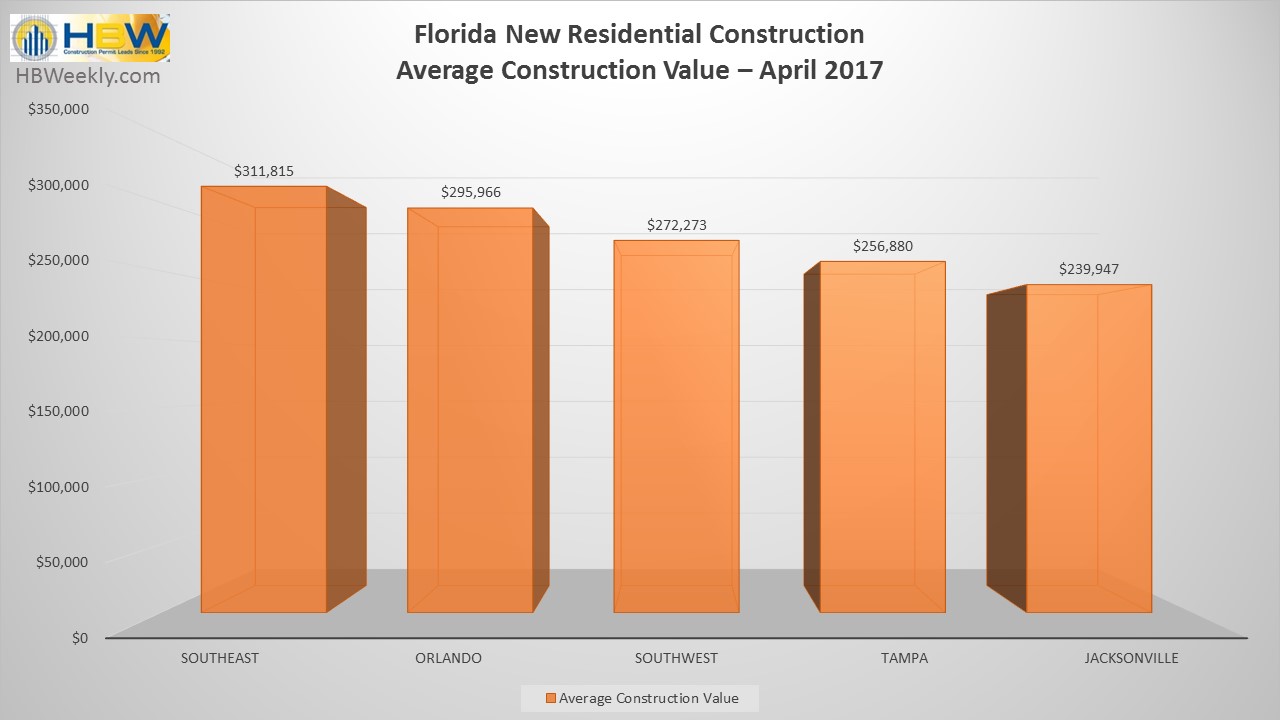
When looking at the average value of residential construction throughout the state, the lineup has remained somewhat consistent every month.  As previously mentioned, the southeast continued to hold the highest average value of housing starts at $351,081.  Orlando held in second highest with an average value of $290,905, while the southwest region was not far behind at $274,519.  Tampa was next in line with an average value of $266,627, and Jacksonville continued to hold the lowest average value for new residential construction at $230,374.

FL Average Value of New Residential Construction - Dec. 2016

FL Average Value of New Residential Construction – Dec. 2016

Information utilized for the graphs and above listed figures for Florida residential construction was directly derived from HBW construction data reports. To gain access to the HBW database and receive custom and detailed reports on the latest residential and commercial building activity in Florida, Georgia, Texas, Alabama, and Oklahoma, please contact HBW for details.

Texas Residential Construction Hits a High Note in December

Despite the holidays and vacations of December, there wasn’t any time lost for residential construction in the Lone Star State.

Texas residential construction received a great gift over the holiday season.  In December, the HBW database had an influx of new residential construction permits in Texas, resulting in more than 5,700 new permits, a month-over-month increase of nearly 70%.  From a yearly perspective, the month of December ranked fourth highest in 2016 for total new permits during any given monthly period.

Texas - Residential Construction Permits Jan. thru Dec. 2016

Texas – Residential Construction Permits Jan. thru Dec. 2016

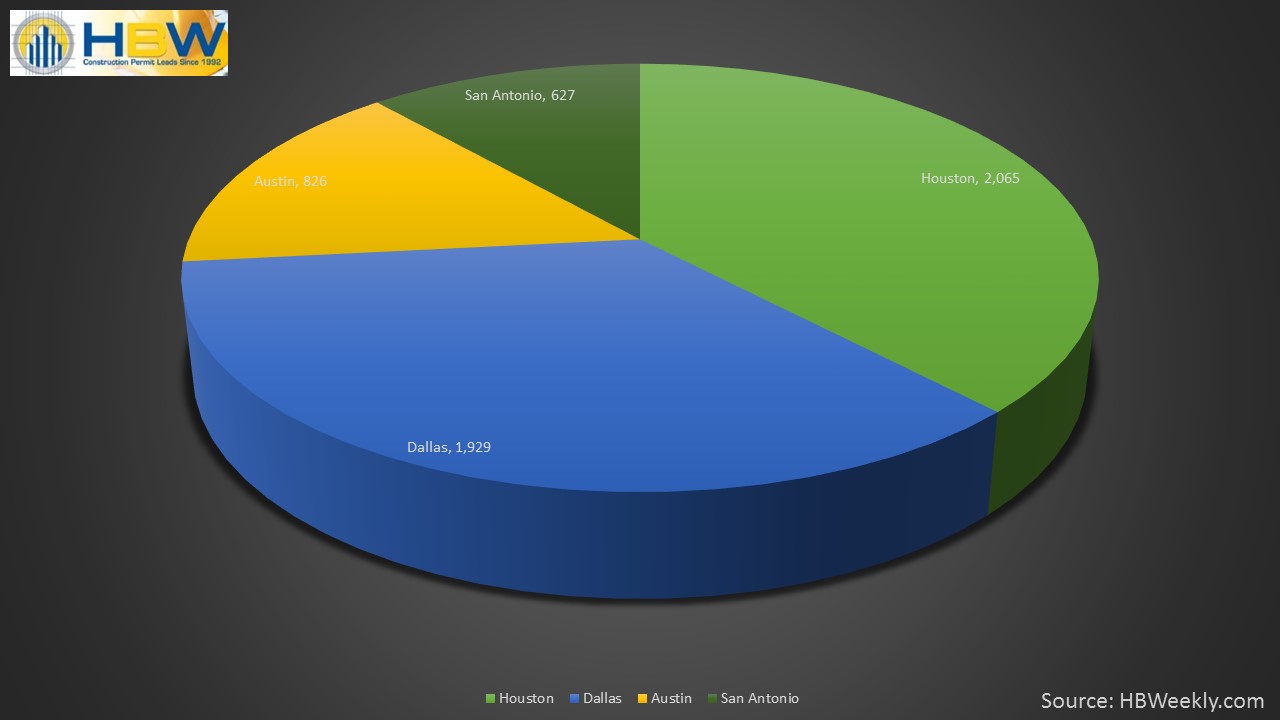
Out of the 5,738 permits and nearly $1.4B in total value in the “Texas Triangle” (Dallas-Fort Worth, Houston, Austin, San Antonio), Houston was #1 for total new permits in December as it experienced a month-over-month increase of 65% in housing starts.  Out of the 2,453 housing starts and approximately $469M in total construction value in the Houston area, more than half of the housing starts took place in Harris County (1,380 permits) while more than 20% originated from Fort Bend County (512 permits).

While Dallas ranked second highest for total housing starts (1,886 permits), it landed the top of the charts for average value at $305,051, and the area had a leading total value of more than $575M in new residential construction last month.  In December, the Dallas area experienced a month-over-month increase of more than 75% in new residential construction, and the county with the highest concentration of housing starts was Collin.

Texas - Total Residential Permits by Area in Dec. 2016

Texas – Total Residential Permits by Area in Dec. 2016

Austin also had a month-over-month spike in new residential construction permits in December; an increase of approximately 67% in comparison to November had Austin ranked third highest with 976 housing starts and nearly $243M in total value.  Nearly all of the housing starts took place in the counties of Williamson (455 permits) and Travis (409 permits).

Although San Antonio had the fewest housing starts on file in comparison to the larger metro areas of Texas, it had an increase of 63% in new residential construction permits since November.  In San Antonio, 423 new permits with a total value of approximately $95.4M were added to the HBW database last month.  More than half of San Antonio’s housing starts took place in Bexar County.

When looking at the average value of new residential construction, Dallas continued to shine.  As previously mentioned, Dallas had an average value of $305,051, significantly higher than the other metro areas within the Texas Triangle.  Austin was ranked second highest at $248,906, while San Antonio came in third with an average value of $225,535.  While Houston led for total housing starts, it had the lowest average value of construction at $191,101 for the month.

Texas -  Average Value of Residential Construction in Dec. 2016

Texas – Average Value of Residential Construction in Dec. 2016

Information utilized for the graphs and above listed figures for Texas residential construction was directly derived from HBW construction data reports. To gain access to the HBW database and receive custom and detailed reports on the latest residential and commercial building activity in Florida, Georgia, Texas, Alabama, and Oklahoma, please contact HBW for details.
5 Tips for Successful Resolutions

How do you make your new year’s resolutions count?  Here are easy ways to increase your chances for achieving your latest goals.

Goals - HBWeekly.com

Resolutions… They are not just for the new year.  No, resolutions are decisions and intentions that you set to accomplish, usually within a given period of time.  Although the new year provides an apropos moment to set such intent, resolutions can and should be happening throughout the year.  Think about it – From new job sites and projects to monthly meetings and new office systems, new goals and directions come about year-round.  In order for these goals and objectives to be successful, there must be realistic expectations, consistent effort and thorough follow through.  Here are five ways to help turn a resolution into a realization:

  1. Document It – If you’ve got a resolution, don’t just talk about it – write it down. Have a place where it is recorded, visible and accessible.  By committing the goal to paper (or file), it is not only reinforced in your own thinking, but it gains a more concrete reality.  Additionally, it gives you time to review it and make modifications if necessary.
  2. Review It – One surefire way to miss a goal is to make it unattainable. To set a goal for success, take time to review it to ensure that it is realistic and based on you or your company’s current timelines and resources, not those that you hope to have in the future.  If there are other team members involved in reaching those goals, include them in the setting and review process for input and feedback.
  3. Break It Down – Now that you have a solid and realistic goal or resolution, break it down by the steps that you will need to take to achieve it. Include a timeline, list of resources, action items, players, stipulations and budgets if applicable.
  4. Set Checkpoints – Incorporated in the timeline should be “checkpoints”. These checkpoints should be set to ensure that you are on schedule and will be able to reach your set goal within the given time frame (one year for resolutions).  An easy general guideline would be to set checkpoints at 25%, 50% and 75% completion; they should include the expected status of action items, available and utilized resources, as well as the players to report on the specific stages of progress.
  5. Follow Through – Once you have achieved your goal, give yourself a pat on the back, but it doesn’t end there. Follow through and maintenance are part of the next stage and usually ongoing for many goals.  If it is a project-based goal, great, you’ve reached the finish line, but if it is a business goal, the journey has just begun.  Just as when you set the goal, you will want to assign key players to maintain the new system or project that has been added.  Just as in checkpoints, you will need to have regular “check-ins” throughout the year to make sure your new endeavor can grow with your business in the years to come.  This can be as easy as adding a new line item to your meeting agenda or requesting quarterly reports from a team member(s).

Resolutions get quite a bit of hype this time of year, but they are essentially goals.  As your business grows, so will your goals.  The success of a business relies on the success of meeting objectives.  By taking a methodical and structured approach to setting and attaining realistic resolutions, you will drive your business to a successful new year, every year.

For more information on construction business and marketing tips, stay connected with the HBW Blog.  To get ahead of construction activity and gain access to the latest permitting data in Florida, Texas, Georgia, Alabama and Oklahoma, contact HBW for more information on construction data reports and industry leads.

Industry Update: 2018 Energy Code

Although it’s constantly in progress and changes won’t be active for another year, here is a quick look at the latest on progress within the Energy Code.

HBW Energy Article

As you most likely already know, the International Energy Conservation Code (IECC) is the model building energy code that is recognized by the U.S. Department of Energy, stated in federal law and used by more than 40 states; the code is updated every three years based on input from code officials, efficiency advocates, builders and more.  The process of updating the code is lengthy, with the latest update having been in progress for over a year.

So why so much emphasis on energy codes in recent years and what is the point?  It’s simple and complex at the same time.  To start, Americans spend more than $200 billion each year on their energy bills (source: EIA).  That being stated, the Department of Energy recently reported that a mere 4%-5% increase in stringency of the building energy code could cumulatively save consumers $126 billion on energy bills from 2010-2040 (source: EnergyCodes.gov), not to mention the importance of sustainability and energy efficiency.  The truth is that it is much more costly and cumbersome to make modifications to an existing building for the purpose of energy efficiency rather than to get it right and more efficient on the front-end and during construction, in this case within the code.

According to the latest from the National Resource Defense Council (NRDC), the 2018 IECC was finally approved by code officials after several rounds of review, and it resulted in support for upholding the efficiency requirements of previous years’ energy codes for building owners. (source: NRDC.org) With the previous code in place and business as usual, there were no major additions, and the gains that were made in previous cycles of the code are being maintained.  There were a variety of proposals, and those that would have significantly weakened the code didn’t make the cut, as well as those that may have helped states and municipalities achieve carbon neutrality.  Although there appears to be a bit of a flatlining in the upcoming code, according to NRDC, there were a few successful proposals that are expected to make homes and businesses more efficient in 2018:

On the residential side of the code, these will clarify how the Energy Rating Index (ERI) path of the code is calculated to ensure consistency for consumers, require a minimum level of efficiency for homes that meet the code with renewable energy, and mandate the installation of more efficient windows in most climate zones. Commercial buildings (including large multifamily buildings) will be required to have more efficient showerheads. (Source: NRDC)

Timeline

Although proposals have been approved, votes still need to be confirmed and certified in the months ahead.  The final version of the 2018 IECC is slated to be published in the middle to end of this year.  Once the Department of Energy has analyzed the energy savings of the new code and all approvals have been processed, states are expected to adopt the code once it goes into effect in 2018.

For more details on the proposals, from position briefs to important dates and timelines, visit the U.S. Department of Energy website here.  Other useful resources include the Building Code Assistance Project, where users can utilize maps that provide a snapshot of building energy code adoption (including the status of energy codes) by state.

For more information on construction industry news, business and marketing tips, stay connected with the HBW Blog.  To get ahead of construction activity and gain access to the latest permitting data in Florida, Texas, Georgia, Alabama and Oklahoma, contact HBW for more information on construction data reports and industry leads.

10 Tips for a Productive New Year

The new year is all about fresh starts and resolutions, making it the perfect time to get organized and set yourself up for a productive year.

productive 2017 HBWeekly.com

A new year brings resolutions, many of which won’t make the cut or endure the year.  From the new gym membership that gets cancelled after a week or two to the fit bit that is worn for a week, the intentions are good, but the follow through is often missing.  So, the question is how do we make solid plans for resolutions that stick.  For one, we make them realistic and attainable.  The same goes for organizing and setting ourselves and businesses up for productivity.   To be productive, we must set a realistic structure with goals and objectives that can be easily attained.  If your resolution is to get more accomplished in an efficient and effective manner, take a look at the following ten tips for being more productive this year:

  1. Remove Distractions – From the constant texts, alerts, emails and phone calls, it is amazing that we can get anything done in one sitting. For this reason, make time in your day (or week) for sessions that have no distractions, and I mean zero.  Route calls to voicemail, have the receptionist take messages and close email for an hour or so.  This is a great time to kick out those pending estimates, finalize design details on a project or complete any other task that requires your dedicated focus.
  2. Morning Matters – To reduce the risk for procrastination, take care of your most dreaded or larger tasks in the morning, when your energy is up and you haven’t taken on the many other planned and unexpected responsibilities of your day. Rudimentary and less complicated tasks can be handled in the afternoon, when your energy levels are lower and your workload or stress may be elevated.
  3. Pen and Paper – Yes, it’s old school, but having a pen and pad of paper can sometimes be the easiest way to jot down those “to do” items or spur of the moment ideas that come up throughout the day. Rather than trying to remember everything for when you have a moment to sit down and record it, take notes throughout the day.  For a more environmentally friendly approach, consider using voice to text note taking on your phone, the voice recorder option, or an app like Evernote or iCloud Notes.
  4. Organize Contacts – If you don’t already have a CMS (Contact Management System), now is a good time to put something in place for accessing and updating contacts. As HBW subscribers receive new contacts with every construction data report, it is important to keep contacts and corresponding notes organized so that your team can quickly and effectively follow up throughout the year.  Consider using a universal system so that all team members can access and modify contacts anywhere and anytime with the system syncing simultaneously.
  5. Plan Daily – Most of us have a running “to do” list, but don’t overlook the importance of scheduling your tasks each day. In the morning, set a clear list of action items for the day; this list should be more than just appointments and will include everything from deadline-driven projects to daily responsibilities.  As you check off each item, you will not only feel more productive, but you will no longer have the need to think about it later.
  6. Organize Office – Those piles that are building up on the corner of the desk and side tables are ready to be addressed. Take time to clear out all clutter and stacks of documents in your office.  If the documents are important, there should be a place for them to be filed.  If they are not important, it is time to purge and shred as necessary.  By sorting through the dreaded and avoided stacks, you may just find something you have been looking for, as well as unnecessary clutter that you didn’t even know existed.
  7. Focus on Results – Much of our day-to-day activity can feel like we are spinning our wheels. For this reason, it is important to make a conscious effort to focus on result oriented activity.  Consider the Pareto Principle when it comes to your input and output; in short, the principle states that 20% of the invested input is responsible for 80% of the results you obtain.  This can apply to your own personal efforts, as well as your team members and even customers to revenue.
  8. Don’t be Afraid to Say “No” – Make this new year a time where you learn your boundaries. We don’t always have the capacity or manpower to take on certain projects, and it is important to say “no” to projects that utilize too many of our resources without enough return.  Nobody wants to say “no” to new clients or projects, but be clear on your capacity and ability to meet requirements within specific deadlines.  As important as it is to not get too comfortable and to push our businesses to grow, it is equally as important to make choices based on realistic parameters and our team’s current capacity and timelines.
  9. Speed Up Your Connections – This one is simple… If your internet connection is lagging or inboxes take minutes to sync, you need to upgrade your speed and functions.  Think about it – If everyone on your team could save ten minutes each day in page or document downloads, your business could save hours every month for more important items.  It is easy to become accustomed to slower connections and processing, but don’t allow it to become the norm.  Make sure the speed of your communication services and computer processors are up to snuff to get more out of everyone’s time.
  10. Trim the Fat – Trim the fat on time-wasting apps and programs. From video games and messenger apps to news feeds and social media, you and your team can go from hero to zero in the productivity sector fast.  Down time can be productive if properly utilized, and addictive time-wasting apps are not the best use of anyone’s workplace hours.  It’s less about the actual time people use the apps and more about the distractions and additional miscellaneous information that flood work time and space that can hinder productivity.  Games and chatting may be an activity of choice after hours, but set the tone with your team to run lean when it comes to social and entertainment apps.

By making a clear and conscious effort to organize and manage your time, you will be able to squeeze a little more out of each day, making 2017 the most productive year yet.

For more information on construction business and marketing tips, stay connected with the HBW Blog.  To get ahead of construction activity and gain access to the latest permitting data in Florida, Texas, Georgia, Alabama and Oklahoma, contact HBW for more information on construction data reports and industry leads.

Quick Tips: Year-End Checklist for Business

Happy New Year, almost.  With the new year being just a day or so away, it means new beginnings for your business, as well as tying up loose ends from 2016.

HBWeekly.com checklist

If your business is anything like the rest of us, chances are the past week or so have not been the most productive.  From the holidays to vacations, many businesses are down a few team members and up on holiday pay.  Although the down time is an opportune time to get organized and prepare for the new year, not everyone planned accordingly.  Even though the first business day of the fiscal year (for most of us) will begin Monday, it’s not too late to prepare for the new year.  Procrastinators can breathe a sigh of relief because with a few reminders and an easy checklist, you will be able to welcome the new year in an organized fashion.  Here is a quick checklist to cover the basics that lie ahead in the coming weeks:

  1. Financials – Although most of the major work behind your financial statements have most likely been reviewed and approved monthly, you should tie up payroll, run year-end reports (P&L, Balance Sheet, Transaction Details), organize tax documents and prepare 1099s to ready your business for the coming months. In addition to collecting and organizing all essential documents, you should have an appointment set with your accountant to ensure that everything is ready and filed in a timely manner.
  2. Performance Reviews – As previously mentioned in our recent post “Rewarding Employees During the Holidays”, holiday bonuses and performance-based bonuses are two separate entities. Don’t let your holiday bonus overshadow the importance of a proper and thorough annual review.  Annual reviews most commonly take place between December and February, and they are the perfect time to review successes and challenges of the previous year, as well as set clear plans for development and expectations for 2017.  Performance reviews are also an opportunity to show appreciation to your team members by recognizing their hard work and providing bonuses based on performance or an agreed upon structure.
  3. Team Development – Although your budget for 2017 is most likely set, don’t forget to leave room for team development. From education to new hires, your team’s growth should match the growth expectations for your business.  With increased volume, there should be an equal and comparable increase in your manpower and capacity.  If you are planning to focus on new or existing services, make sure your team is sharp and ready to handle the increased focus and demand.  Within the first couple of weeks of the new year, it may be beneficial to hold a team meeting to provide details on plans for the coming year (especially additions and modifications) and direction to each department so that everyone starts on the same page.
  4. Technology Tune-up – This item also goes along with your budget, and taking stock in your current technology is another important task. Even if it is not an investment that can be made this year, take the time to plan for the year ahead.  Are your computers, mobile devices and communication services up to snuff?  Are your software applications and systems updated and able to handle your workload efficiently and effectively?  Check that you have everything in place to protect your business data and customer data such as credit cards and personal information.  Also, data for 2016 should already be backed up and stored for safe keeping, and your system should be checked to make sure all backups are occurring regularly and are properly scheduled for the coming year.
  5. Cut Expenses – The new year provides a chance for reflection and review, and overhead should be included. A thorough review of your day-to-day business expenses can lead to great savings over time.  Do you need or use all of your current subscriptions to magazines or software?  Are you getting the best rate on your credit cards and other accounts?  Are you using all cell phones and data plans that are active with your phone service provider?  Even if you have a solid bookkeeper, you should make a habit of reviewing these operational services and expenses on an annual basis.
  6. Take Inventory – Whether you sell or directly produce products, take inventory of all products or raw materials on hand at the start of the new year. Although you most likely have a running total, make sure you have clear figures recorded for the end of year inventory on January 1st to avoid having to assess the figure by counting back later.
  7. Back It Up – Assuming that you have performed a “technology tune-up” (see #5), you should have 2016 backed up. In addition to your critical financial data and document files, remember to backup phones, email and communication files.  If company phones are not already set for automatic backup to the cloud, all team members should be required to backup their phones to avoid lost time should a phone break or be misplaced.

The closing of 2016 opens a new year and chapter for your business.  Start off strong by organizing and backing up the necessities from 2016 and using the data collected to prepare for a year of growth and success in 2017.  By checking off the essentials, you will be clearing the slate and making room for new jobs and new business in the months ahead.

For more information on construction business and marketing tips, stay connected with the HBW Blog.  To get ahead of construction activity and gain access to the latest permitting data in Florida, Texas, Georgia, Alabama and Oklahoma, contact HBW for more information on construction data reports and industry leads.

Industry Insight: Popular Predictions for 2017

From expected color trends to real estate markets, here is a look at some of the latest industry predictions that are abuzz for 2017.

HBW trend update 2017

The buzz has begun – you know the one that begins before every new year.  From top resolutions to industry expectations, your news feed is probably chock-full of ideas and guides for 2017.  Within the construction industry, the amount of predictions for everything from design trends to real estate markets can be overwhelming.  There are simply so many articles and too little time to read them all, even if you add in the flight and layover time from your holiday travels.  To make it easy, here are just a few popular industry predictions to satiate your curiosity and get you in the know on the latest buzz for 2017:

  1. Colors – For those readers who work primarily on interiors, this one may not be a surprise. The top color for 2017 is green, and we’re not just talking about sustainability and the act of going green – this is actual green.  According to Pantone Color Institute, the color of the year for 2017 is “Greenery” (Pantone 15-0343). As published on Pantone’s website, Leatrice Eiseman, Executive Director, described the color as meeting the need to “rejuvenate, revitalize and reconnect with nature.”  As for pairings, the color works well with neutrals, deeper shades, pastels, metallics, as well as the 2016 colors of the year “Rose Quartz” and “Serenity”.  As with any prediction, there is bound to be some difference in perspective.  When looking at predictions from specific paint manufacturers, the expected color palette changes quite a bit…
    1. Benjamin Moore Shadow
    2. Glidden Byzantine Blue
    3. Kelly-Moore – Kettleman
    4. Sherwin-Williams – Poised Taupe
  2. Hot Markets – What defines a “hot” market? Well, there are a number of factors that contribute to making an area hot for real estate including job opportunities, affordability and availability.  As per the latest from Trulia’s chief economist, Ralph McLaughlin, several of the top ten markets are in HBW’s areas of focus – Florida and Texas.  In fact, five out of ten on the list are in Florida, with Jacksonville, Cape Coral-Fort Myers and Deltona-Daytona Beach-Ormond Beach listing as the top three markets.  Other areas in Florida that are considered markets to watch are the Tampa/St. Petersburg area and North Port-Sarasota-Bradenton.  In Texas, San Antonio is expected to gain some ground, and all areas that are considered “hot” are based on how well they are positioned for growth.  As with any prediction, time will tell.  At HBW, the regular reports on construction data for both residential and commercial construction will reveal the details on new construction permits and how the activity compares to these predictions throughout the year.
  3. Design – For design trend predictions, Zillow recently provided a Zillow Digs Home Trend Forecast that brought velvet back to the forefront. The forecast analyzed data collected from surveys of interior design experts as well as analysis of the most popular photos on Zillow Digs.  The combined effort resulted in four top trends: velvet, jewel colors, marble surfaces and built-in bars.  Overall, the theme appears to be leaning toward warm and cozy. The trends that are expected to make their way out in the coming year include industrial style furniture, cool gray tones and quote art.

Keep in mind, predictions and trends are far from an exact science, and they will often vary from source to source.  Although it is helpful to know what is buzzing in the industry and with consumers, it shouldn’t take away from the value of listening to your clients.  Not everyone’s ideas for design and color will follow the latest trends, so although the buzz is good to share, your client’s interests will continue to be the ultimate guide for you in the coming year and beyond.

For more information on construction business tips and industry trends, stay connected with the HBW Blog.  To get ahead of construction activity and gain access to the latest permitting data in Florida, Texas, Georgia, Alabama and Oklahoma, contact HBW for more information on construction data reports and industry leads.

OSHA’s Final Rule on Workplace Injury/Illness Recordkeeping

Just in time for the new year, OSHA recently issued a final rule regarding the maintenance of records for recordable injury and illness. 

source: OSHA.gov

source: OSHA.gov

You may have heard about a final rule being released by OSHA regarding recordkeeping for workplace injuries. If not, don’t panic. The final rule, issued December 19, 2016 (effective January 18, 2017), serves primarily as a clarification and reminder that recordkeeping of work-related injuries and illnesses is an ongoing requirement for employers.  The official title of this latest final rule is “Clarification of Employer’s Continuing Obligation to Make and Maintain Accurate Record of Each Recordable Injury and Illness.” (December 19, 2016)

The latest rule was solely clarification of the existing regulation; according to OSHA’s recent press release (December 16, 2016), there are no major changes expected in the near future so take a deep (cue sigh of relief).  No major changes aside, it is worth paying attention to their clarification to ensure that you and your team understand injury/illness recordkeeping obligations.  Now, you should already have an injury record keeping system in place that is OSHA compliant. Whether you do or do not, here is a short list of the basics you need to know about the latest rule:

  • Clarification – The new final rule simply states employers’ obligations, which has been standard practice for the last 40 years. According to a recent press release by OSHA, Dr. David Michaels, the Assistant Secretary of Labor for Occupational Safety and Health, stated “This rule simply returns us to the standard practice of the last 40 years.  It is important to keep in mind that accurate records are not just paperwork; they have a valuable and potentially life-saving purpose.” (source: OSHA.gov).
  • No Change – Although the recent amendments contain revisions to titles of several existing sections and subparts, as well as changes to text in existing provisions, nothing has been added that requires you to drastically change what you have already been doing in this area of recordkeeping. The latest final rule does not add new compliance obligations and does not require you, the employer, to make new records for any illnesses or injuries that don’t already require such documentation.
  • Ongoing – As stated in the latest final rule, the duty to record an injury or illness continues for as long as the employer must keep records of the recordable injury or illness – there is no expiration for this responsibility, even in the case where the employer neglects to create the necessary records when first required to do so.

Long story short, the latest final rule is more of a formality and reiterates OSHA’s established position that an employer’s duty to record an injury or illness does not cease and continues for the full five-year record-retention period.  Bear in mind, OSHA has stated the ability and right to cite employers for such recordkeeping violations for up to six months after the five-year retention period expires.

Now that you have the basics, share it with your team so that they can also perform a quick review as well as be prepared should an unfortunate workplace incident/injury arise. It is also a good time to review your safety policies and procedures.  As the above listed information covers the bare bones of the latest final rule, visit OSHA.gov for more detailed information about workplace injury recordkeeping and employers’ requirements.

To gain direct access to details of OSHA’s recordkeeping requirements as they relate to injury and illness, visit their recordkeeping rule page.  For more information on construction business and marketing tips, stay connected with the HBW Blog.  If you would like to get ahead of construction activity and gain access to the latest permitting data in Florida, Texas, Georgia, Alabama and Oklahoma, contact HBW for more information on construction data reports and industry leads.