Florida’s Top Counties for Commercial Construction – February 2016

se fl comm. HBW

Spring Break is here, and with Florida being home of the Spring Break capital of the U.S., it is the perfect time to look at commercial construction in the Sunshine State.  Earlier this week, our review of residential construction in Florida showed the state on the upswing since January.  Taking a look at commercial construction last month, there were nearly 330 commercial starts and more than 1,000 alterations (including renovations and additions).  With a new commercial construction value in excess of $1.2 billion and $460M in alterations in February, Florida had various counties seeing the bulk of commercial construction activity for the month.

New Commercial Construction

Using HBW construction data reports, we were able to customize our search for the highest concentration of new commercial construction leads throughout Florida.  In February, Miami-Dade County of South Florida held the #1 spot for highest new commercial construction value ($318.5M), while Orange County (Orlando) was #1 for total commercial starts (44 permits).  When looking at alterations and renovations, the leaders switched as Miami-Dade led for total permits (122), and Orange County led for total value ($77.5M) for the month.

Miami-Dade and Orange County were not the only areas with new commercial starts on file for February.  The area with the second highest total for commercial starts was Hillsborough County (Tampa) with 27 starts and nearly $168.6 million in total construction value.  South Florida held the third and fourth spots for total new commercial construction permits.  Miami-Dade had 24 starts and a total value in excess of $318.5 million, and Palm Beach County also had 24 starts with a total value just over $52.4 million.  Not far behind, Polk County (Tampa) had 23 new commercial construction permits and a total value close to $100.6 million.

FL Top 5 Counties - New Commercial Construction Feb. 2016

FL Top 5 Counties – New Commercial Construction Feb. 2016

Commercial Alterations

As previously mentioned, commercial alterations refer to all alterations, renovations and additions.  In Florida, Miami-Dade County was #1 for total alterations with 122 permits and more than $43.4 million in total value.  Orange County wasn’t far behind with 109 permits and a total value in excess of $77.5 million.  Palm Beach County (SE) came in a close third for alterations with 103 new permits on file in February and a total construction value greater than $48.1 million.  Hillsborough County (Tampa) held the fourth top spot with 101 alterations on file and more than $70.3 million in total construction value.  The northern portion of the state in Jacksonville also had some new commercial activity on file as Duval County had 98 alterations with a value of more than $46.3 million.

FL Top 5 Counties for Commercial Alterations - Feb. 2016

FL Top 5 Counties for Commercial Alterations – Feb. 2016

Information utilized for the graphs and above listed figures was directly derived from HBW builder data reports. To gain access to the HBW database and receive custom and detailed reports on the latest building activity in Florida and beyond, please contact HBW for details.
Florida New Residential Construction Report – February 2016

New residential construction in Florida had a boost last month with a 19% increase in activity in comparison to January.

homebuild increase fl

Florida has gained some forward momentum since the start of the year.  With nearly 4,800 housing starts on file with HBW for the month of February and a total construction value in excess of $1.4 billion, Florida residential construction activity increased last month in all areas from Jacksonville to South Florida.  Although the southwestern portion of the state has led residential permitting totals in recent months, Orlando took the lead last month with an 18% increase in residential construction activity since January.  Orlando held the top spot for total starts and total construction value with 1,162 permits on file for the month and a total value in excess of $356.6 million.

Not far behind, the southwestern region of Florida experienced a 12% increase in residential construction since January, with 1,149 housing starts and a total value greater than $320.6 million.  On the heels of SW Florida, Tampa’s 6% increase in new residential construction activity positioned it in third, with 931 housing starts and more than $251.1 million in total value. Although Jacksonville and SE Florida held fourth and fifth for total permits, both areas experienced the greatest increases in residential construction activity for the month. Jacksonville was up by 38% with 874 permits and a value of more than $206.5 million, and the southeastern region saw a massive 55% increase in activity with 672 new permits and nearly $272.5 million in total construction value.

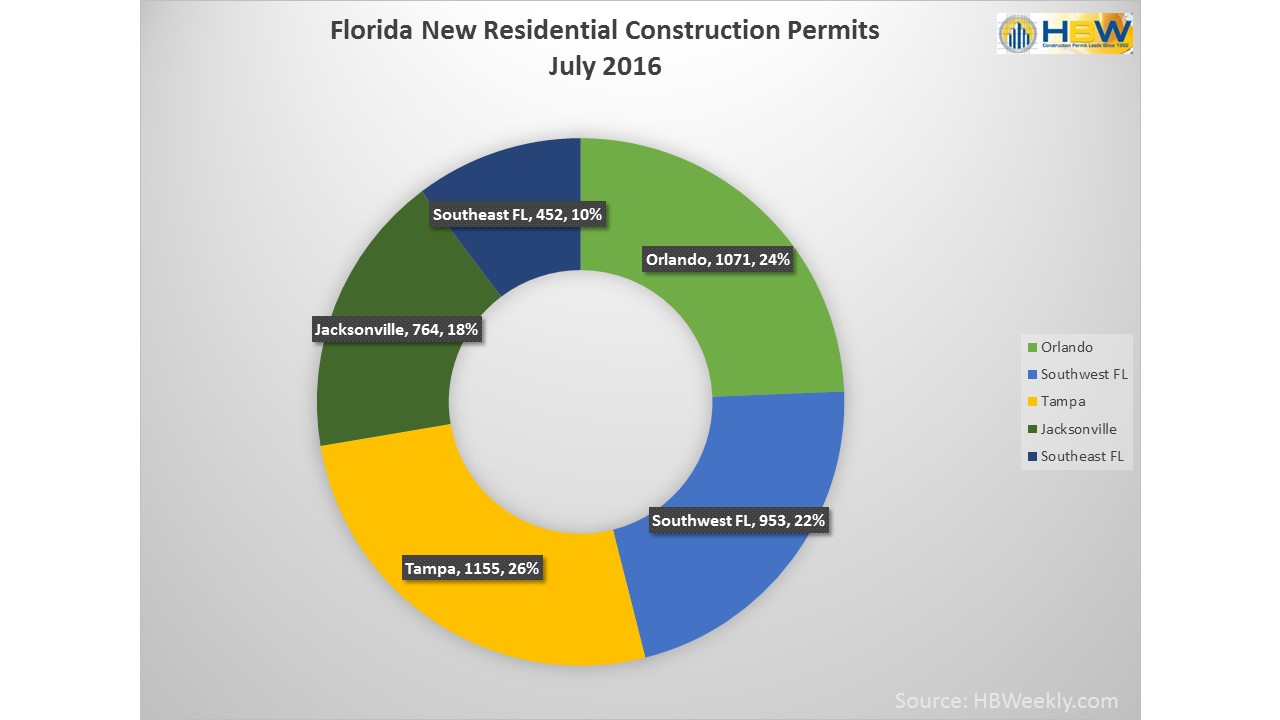
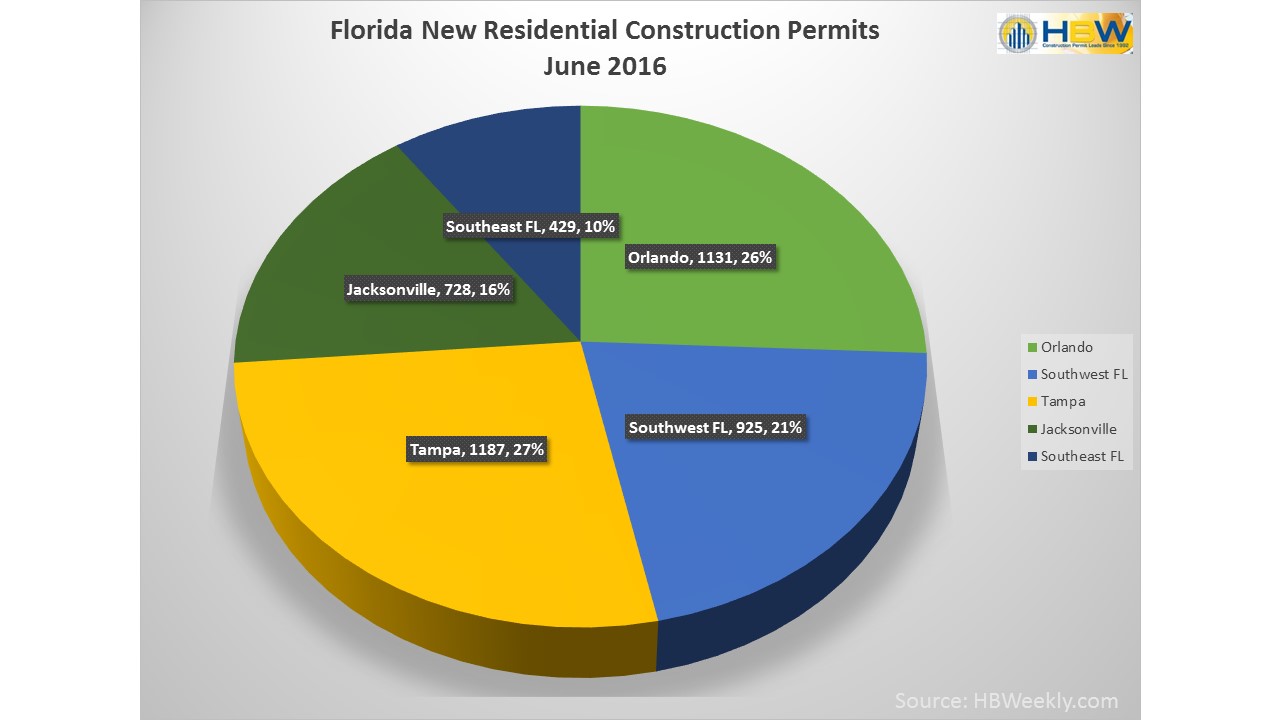
FL New Residential Construction Permits - Feb. 2016

FL New Residential Construction Permits – Feb. 2016

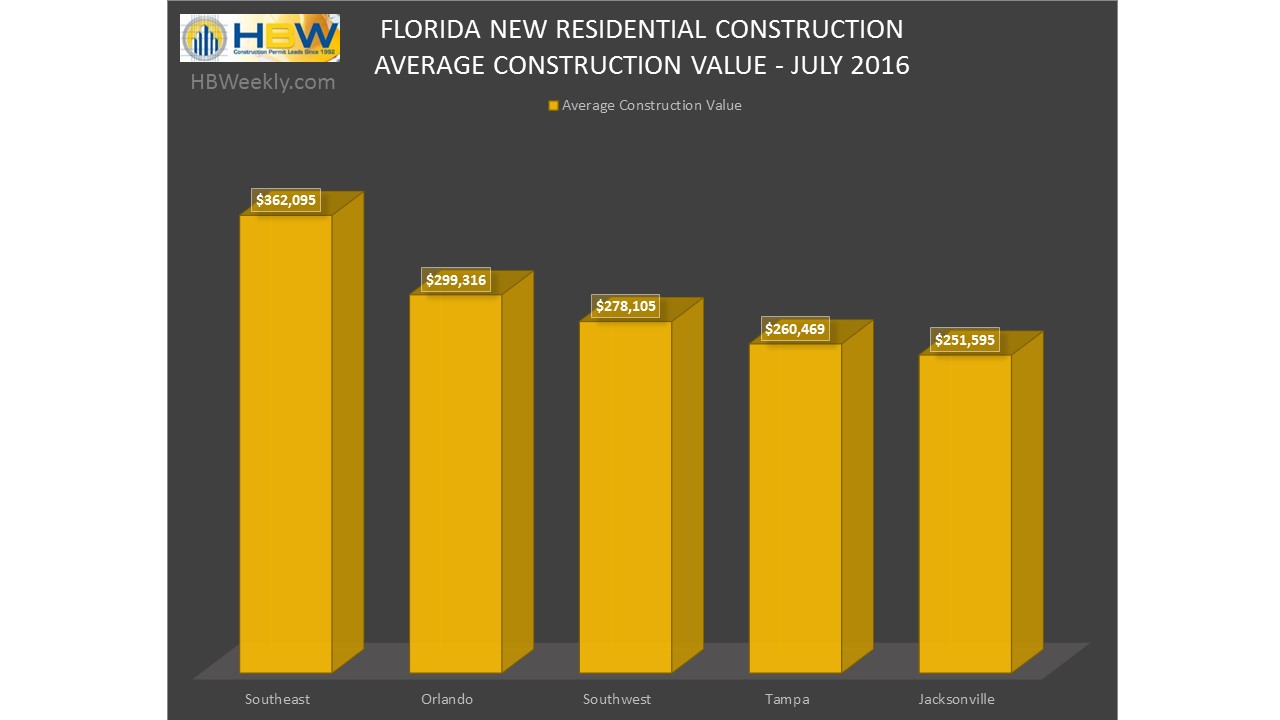
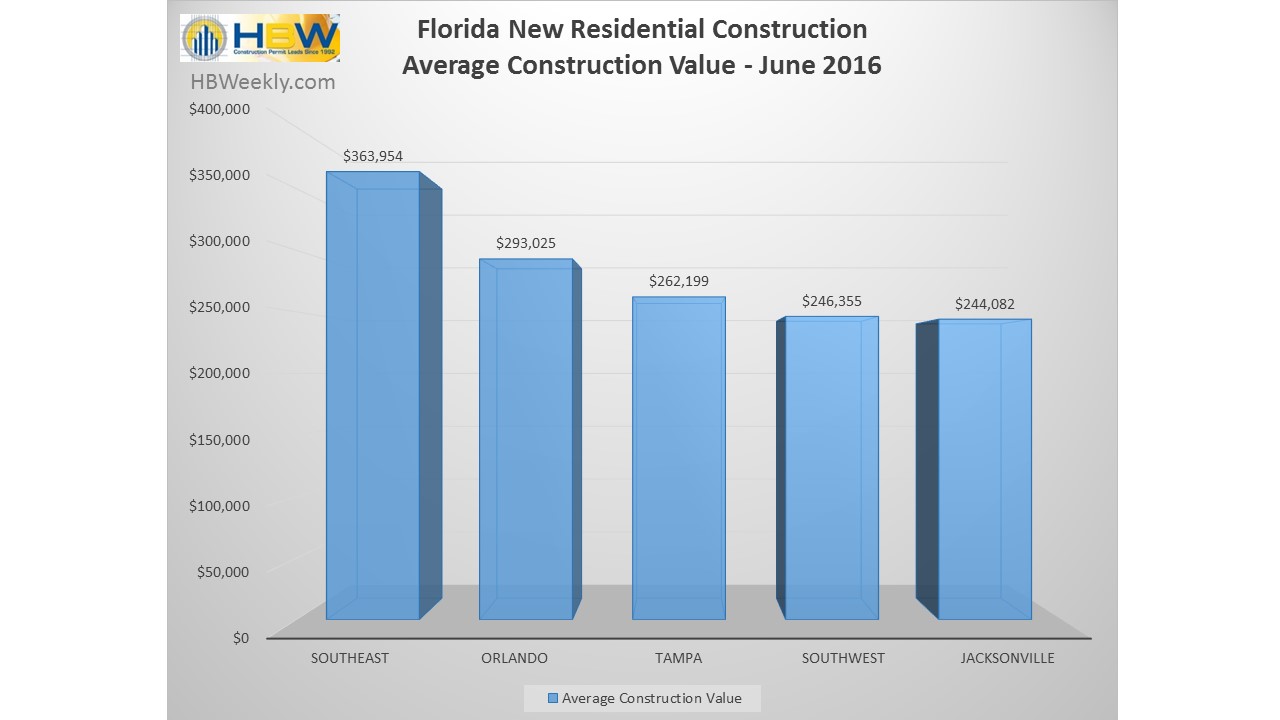
When looking at the average value of new residential construction in Florida last month, SE Florida stands out on top with an average value of $405k.  Orlando held strong in second with an average construction value of nearly $307k, while SW Florida was third highest with an average value of approximately $279k.

FL Average Residential Construction Value - Feb. 2016

FL Average Residential Construction Value – Feb. 2016

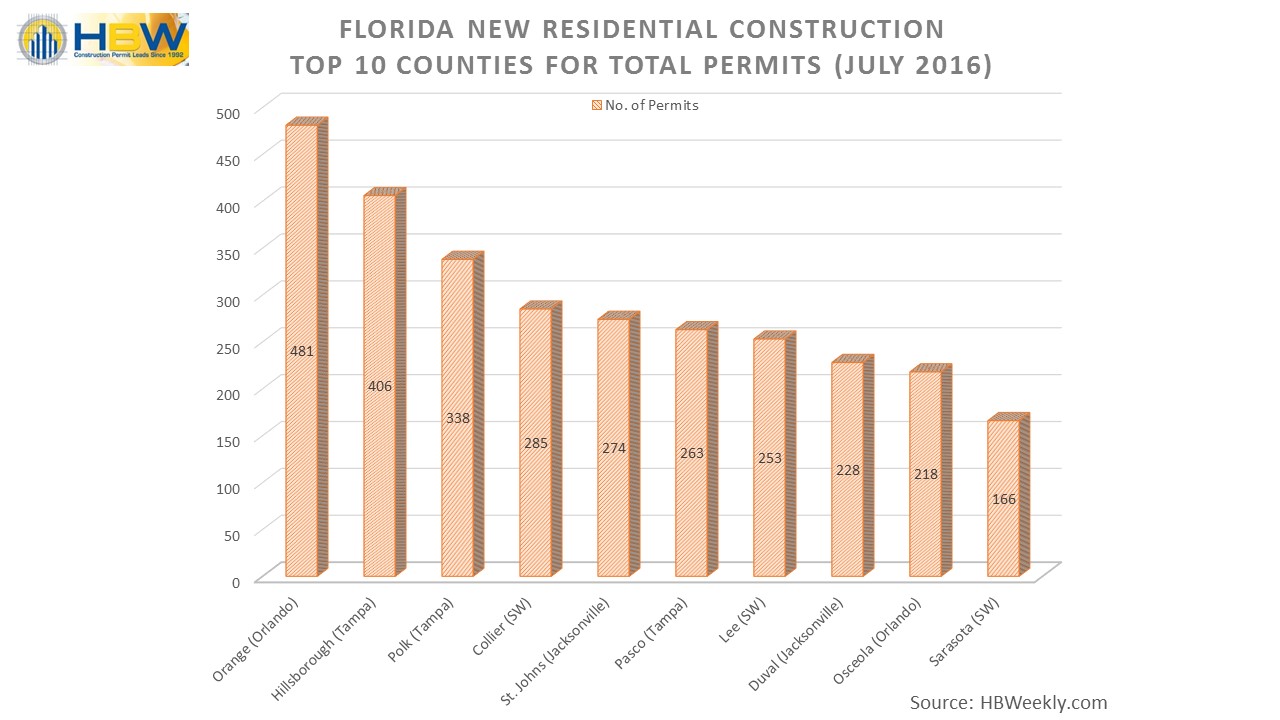
Using HBW reports for a more detailed breakdown of new residential construction in Florida, we are able to identify the counties with the greatest concentration of activity last month.  Areas like Jacksonville that didn’t lead for total starts have counties that are standouts and in the top 3 when compared to counties across the state.  Orange County (Orlando) experienced a 15% increase in activity since January and continued to hold the number one spot with 520 housing starts and a total value of approximately $178.3 million.  St. Johns County in Jacksonville held the second highest for total permits with 334 housing starts (a 25% increase since January) and more than $90.5 million in total value.  Duval County’s (Jacksonville) impressive 42% increase in activity resulted in a jump from #8 to #3 with 310 housing starts and more than $55.2 million in total construction value.  The southwestern portion of Florida took fourth and fifth as Collier County had 298 starts (total value: $121.4M) and Lee County had 293 starts (total value: $72.6M).

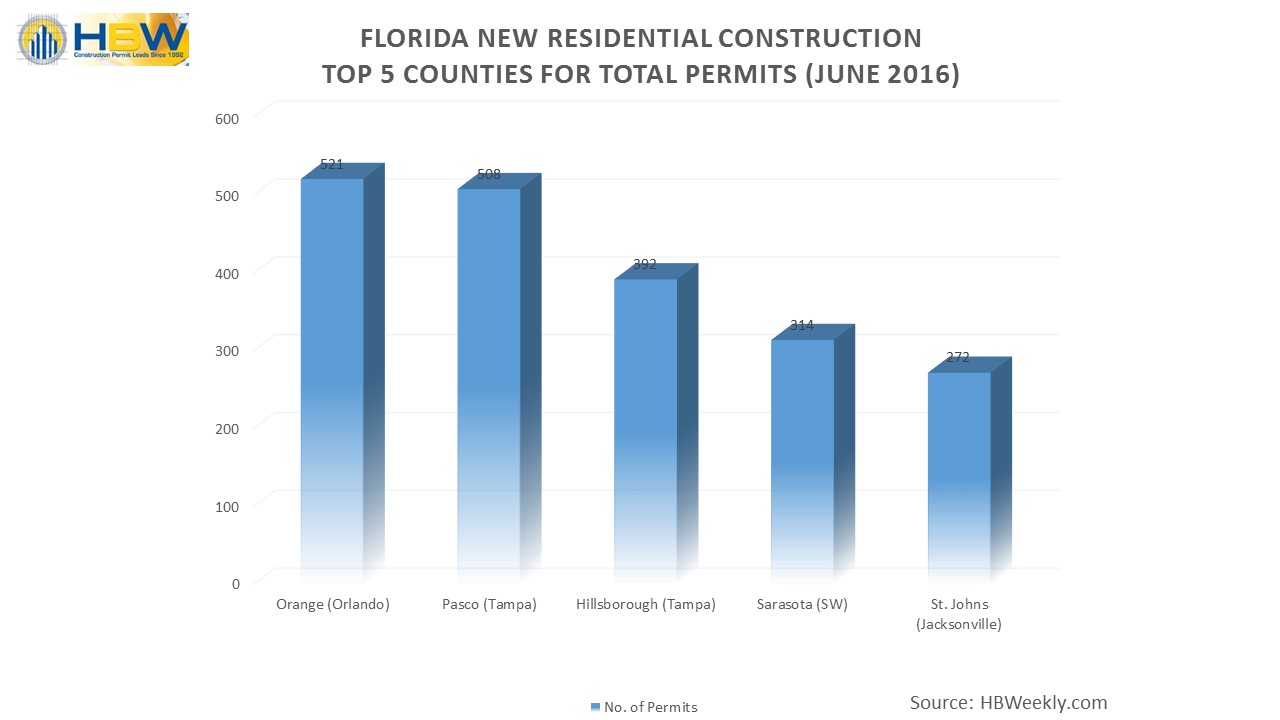
FL Top 10 Counties for Permits - Feb. 2016

FL Top 10 Counties for Total Permits – Feb. 2016

Information utilized for the graphs and above listed figures was directly derived from HBW builder data reports. To gain access to the HBW database and receive custom and detailed reports on the latest building activity in Florida and beyond, please contact HBW for details.
Texas Commercial Construction – February 2016

Using the HBW database, we discovered approximately 1,400 new commercial construction projects in Texas.  Here’s the scoop on the top counties for February…

tx.comm-hbweekly

When it comes to commercial construction, Texas is a state to watch.  According to Site Selection magazine, Texas is ranked No. 1 overall based on the number of new and expanded facilities projects constructed in 2015.  HBW subscribers in Texas already know about the nearly 1,400 new commercial projects that started in February throughout the state.  From new construction to alterations (including renovations and additions), county-to-county, more than $1.4 billion in commercial projects started last month.

Using the HBW database to gain detailed insight on where the bulk of commercial construction activity is taking place, Harris County in Houston was a clear winner in both new construction and alterations in February.  From Houston Baptist University’s $60 million expansion to new recreational facilities like a high-end bowling alley (CityCentre) and Nike’s Golf Performance Center at Bluejack National Resort, Houston has quite an array of newsworthy construction projects that are catching attention.  Just in Harris County, there are more than 500 commercial construction projects and alterations on file for February; in new commercial construction there were 116 starts for the month with a total value of more than $510 million.  Taking second behind Harris County is Bexar County in San Antonio, with 57 new permits and a total construction value in excess of $154.5 million.

The Texas County that was third highest in new commercial construction activity is Tarrant County which is located in the Dallas area. Known for its boom in real estate and higher-priced properties, Dallas has its fair share of commercial development.  Some of the latest construction projects highlighted in the Dallas Business Journal recently include Equinix’s awaited unveiling of a new $20 million data center in Legacy Business Park, and new redevelopment projects like that of the Lorenzo Hotel.  In February, 45 new commercial permits in Tarrant County were added to the HBW database with a total construction value of nearly $224 million.


TX Top 5 Counties - New Commercial Construction Feb. 2016

Texas Top 5 Counties – New Commercial Construction Feb. 2016

Commercial alterations led the bulk of commercial construction activity in Texas last month, and Harris County in Houston took the #1 spot again with 393 permits and a total value of nearly $254 million.  Two counties in Dallas (Dallas and Tarrant) held the second and third spots for commercial construction alterations.  Dallas County has 180 commercial alterations on file and a total construction value above $66.4 million, while Tarrant County has 106 permits on file for alterations in February and a total value of nearly $69 million.  Here’s a look at how the top five counties stacked up in total commercial construction alterations for the month:

Texas Top 5 Counties - Commercial Alterations Feb. 2016

Texas Top 5 Counties – Commercial Alterations Feb. 2016

Information utilized for the graphs and above listed figures was directly derived from HBW builder data reports. To gain access to the HBW database and receive custom and detailed reports on the latest building activity in Texas and beyond, please contact HBW for details.
HBW Report: Texas Residential Construction – February 2016

Permit totals from February have been tallied, and housing starts in Texas increased by 18% in comparison to January.

tx

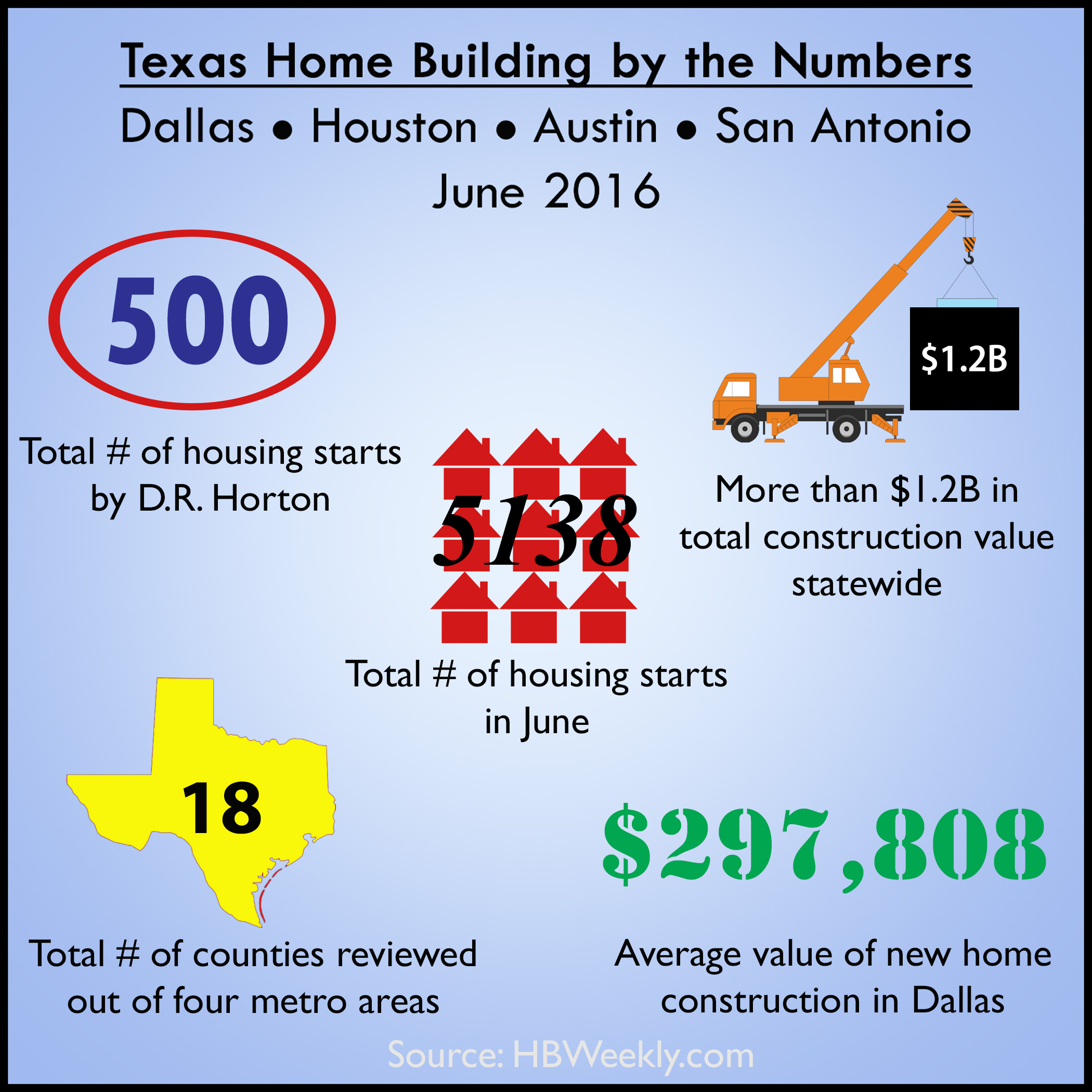
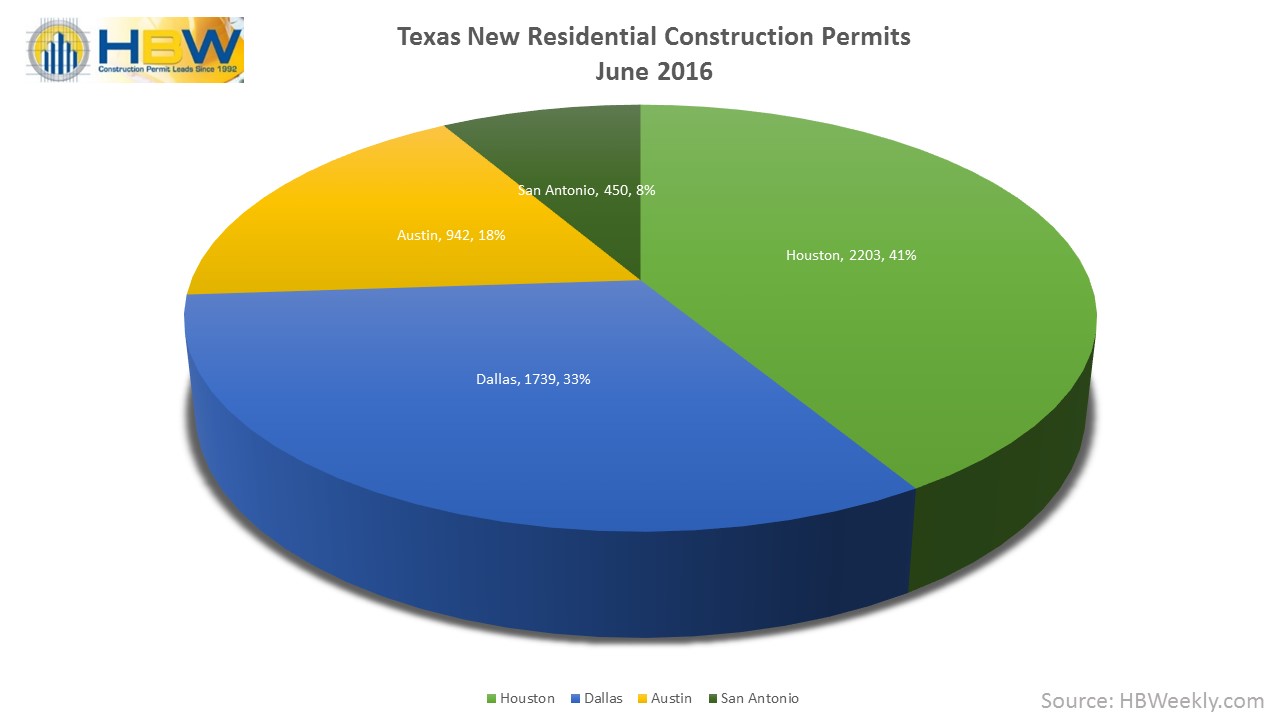
Late last month, Realtor.com revealed its top 20 hottest U.S. real estate markets for February 2016, and Dallas, Texas was in the #3 spot out of 20 U.S. cities.  Dallas continued its upward climb in the HBW database in February as well, along with Houston for residential construction.  From Dallas, Houston, Austin and San Antonio, there were more than 5,100 housing starts on file for the month, with a total construction value in excess of $1.2 million.

The area with the greatest total number of permits for February was Houston, with 2,262 housing starts and approximately $420 million in total value – a 15% increase since January.  As previously mentioned, Dallas continues to rise since the start of the year.  Last month, there were 1,706 new residential permits on file for Dallas which is a 21% increase in comparison to January; additionally, Dallas held the highest total construction value for the month with more than $544 million in residential construction.

Experiencing the greatest increase since January, San Antonio’s residential construction activity was up by a whopping 80% with 512 housing starts and a total construction value close to $112.8 million.  The only area that we reviewed in Texas that experienced a slight decline (-5%) in residential construction permits was Austin.  According to the latest from the HBW database, there were 701 new residential permits in Austin for February and a total construction value in excess of $171.1 million.

Texas Residential Construction Permits - February 2016

Texas Residential Construction Permits – February 2016

Since January, there were a few shifts in position in the top 5 counties for the month.  Harris County (Houston) continued its lead in the #1 spot for total housing starts in February.  Harris was remarkably steady and consistent with 1,050 starts for the month and a total construction value of $191.5 million.  Jumping up one spot to the second highest for total permits, Fort Bend (Houston) had 594 new residential construction permits and a total value greater than $97.2 million.  Although up by 8% since January, Collin County (Dallas) dropped one spot to #3 for the month with 522 housing starts and the second highest total construction value of nearly $169.3 million.  Tarrant County (Dallas) moved up one spot since January and was fourth highest for total permits in February, with 499 housing starts and more than $128.7 million in total construction value.  Travis County (Austin) slipped back one spot to #5 with 367 total permits and a monthly construction value of more than $89.1 million).

Texas Top 5 Counties for Total Permits - February 2016

Texas Top 5 Counties for Total Permits – February 2016

Monthly summaries are intended to provide the latest on lead information available through HBW’s construction data reports and services.  Construction fluctuations in any given area on a monthly basis are normal and expected.  For a comprehensive understanding of residential construction patterns based on permitting activity, check out the HBW Blog’s Quarterly Reports and Year-End Reviews.

Information utilized for the graphs and above listed figures was directly derived from HBW builder data reports. To gain access to the HBW database and receive custom and detailed reports on the latest building activity in Texas and beyond, please contact HBW for details.
Industry Update: AIA Reports Top Nonresidential Design Trends

AIA surveyed leading architects, and the results revealed that efficiency and sustainability are at the top of the list for the construction process and lifespan of buildings.

Sust.Bldg - HBW

According to its most recent Semi-Annual Consensus Construction Forecast, AIA (American Institute of Architects) reports a projected increase in construction spending by more than 8% in 2016.  The report is based on projections provided by the nation’s leading construction forecasters including Dodge Data & Analytics, IHS Economics, FMI, Associated Builders and Contractors, and Wells Fargo Securities to name a few.

Another area in construction expected to see growth is that of sustainability. Last month, AIA published a press release revealing results from a recently conducted survey of leading architects.  The survey was designed to gain a clearer perspective and understanding of how nonresidential building design is expected to evolve over the next 10 years. As new technologies continue to develop at an unprecedented pace, it is no surprise that the survey indicates renewable energy and innovations in technology as a driving force behind the changes to come.

The AIA report stated that the following nonresidential design trends will become increasingly more popular as sustainability continues to be an area of focus:

  • Water conservation
  • Solar power
  • Wind power generation
  • Natural “day-lighting” techniques
  • Smart/motion-sensor lighting systems


According to the report and architects surveyed, a number of innovative materials and tools will also gain more use and attention; some of the materials and methods expected to increase in use in nonresidential construction over the next 10 years include:

  • Composites
  • New glass/glazing technologies
  • BIM (Building Information Modeling) software
  • Alternative and efficient project delivery methods
  • Lean construction practices


Although green design and sustainability are not new concepts in construction, the report indicates that the focus on efficient construction and design will continue to expand and strengthen in the industry.  This growth will be driven by the increased need and demand for projects that have less impact on the environment through both design and energy-saving methods and technologies.  Ultimately, leaner processes and energy efficient designs are desired by building owners because along with saving energy, sustainable designs can also offer savings for the budget in the long-term.

To remain current on the latest construction business tips and industry updates, stay connected with the HBW Blog.  For access to detailed construction activity and permitting data in Florida, Texas, Georgia, Alabama and Oklahoma, contact HBW for more information.

Drone Use for Home Builders

Aerial photos are a great way to showcase your latest project, but if you are going to use drones, be aware of the potential liability.

HBWeekly.com drone use

Drone use is becoming increasingly more popular, and according to the FAA, the number of drones flying the U.S. skies could reach as high as 30,000 by the year 2020.  Along with increased popularity, drones are becoming more of a liability with various risks and associated penalties.  The power of high-quality images and videos in marketing for home builders is undeniable.  An aerial video tour or panoramic view of a new roof, finished pool, landscaping project or home can be a major asset in selling to potential customers and building a portfolio.  As tempting as it may be to buy a drone and begin documenting your latest designs, take a moment to pause and consider the implications of drone use.

According to the FAA, a drone is classified as an “Unmanned Aircraft System”.  What does this mean to you?  Basically, all aircraft systems must be registered, so in order to use a drone owned by you or your business, you must register it as required by Federal law.  Although there was initially a grace period for unregistered drones late last year, as of February 19, 2016, all small unmanned aircraft owners must register their aircraft if they wish to continue to operate outdoors. Registration is easy and only requires a nominal fee ($5).  Skipping the registration process can result in much higher fines and regulatory and criminal sanctions. Civil penalties can be as high as $27,500, and criminal penalties can reach $250,000 and/or imprisonment for up to three years.  Bottom line: Register your drone.  Currently, commercial use of drones is a paper-based registration process, but the forms can be accessed online; the system for commercial drones is expected to transition to web-based later in the year.

Along with registration, how and where you operate your drone is important.  Before taking flight, consider the following:

  • Airports – If your project involves an airport or is within 5 miles of one, contact the airport and control tower before flying your drone.
  • Privacy – When covering residential projects, make sure to keep the drone on your project only. Flying over other homes, backyards or other properties puts you at risk for privacy issues.  Check and follow all local laws and ordinances prior to flying over private property. If in a gated community, make sure to check their regulations (if any) as well. You may also refer to AMA’s (Academy of Model Aeronautics) privacy policy as a guide.
  • Visual – It is suggested that drones fly below 400 feet. Always keep the aircraft in line of sight, and take note and stay clear of any potential obstacles prior to flying.
  • Identification and Insurance – Ensure the drone is properly marked and easily identifiable. If flying outdoors, include the name and address or AMA number of the owner on the inside or outside of the aircraft. Also, check with your insurance provider to see what may be covered and if you need to add additional levels of insurance to your policy.
  • No Fly Zone – Know where you can and cannot fly. In addition to airports, do not fly your drone near people, stadiums, or sensitive public facilities (power plants, correctional facilities, high-traffic roadways, sewage plants, government buildings).
  • Ability – Whether you or a staff member will be operating the drone, make sure they are trained and have practiced controlling the device, including take-off and landing. Just as you would when operating any vehicle, take care and stay in control.  Irresponsible or reckless use can result in fines for endangering people or other aircraft.

Laws governing the use of drones are in development as the technology is new. If you are contemplating using drones on your job site, it is advisable to seek legal advice from an attorney to ensure that you are aware of potential issues and operate your drone in a manner that limits liability. To learn more about drone safety and guidelines, check out “Know Before You Fly”.  “Know Before You Fly” is an educational program resulting from a partnership with the FAA and founded by the Association for Unmanned Vehicle Systems International (AUVSI), and the Academy of Model Aeronautics (AMA).

For more information on construction business tips and industry updates, stay connected with the HBW Blog.  To get ahead of construction activity and gain access to the latest permitting data in Florida, Texas, Georgia, Alabama and Oklahoma, contact HBW for more information on construction data reports and industry leads.

HBW Report: Texas Swimming Pool Construction – January 2016

More than 450 new swimming pool permits were added to the HBW database in January, and Dallas is leading the way.

HBW report pls-TX

Looking for the latest on swimming pool construction in Texas? Texas is holding steady for the start of the year as swimming pool construction for January remained consistent with December’s figures.  When reviewing Dallas, Austin, Houston and San Antonio, more than 450 new swimming pool permits with approximately $23.2 million in construction value were added to the HBW database in January alone.  Leading construction activity as usual, Dallas continues to hold steady having a slight 2% increase in activity since December and 264 new permits (total value: $11.3 million+).

Another area that saw a slight increase since December is Houston.  The area experienced close to a 7% increase in pool construction activity, with 98 new permits and a total construction value in excess of $6 million on file for January.  On the other hand, Austin was slightly down since December (6% decrease) with 51 pool starts and a total construction value close to $3.6 million.  Approximately 89% of all new pool permits in Austin were out of Travis County.  Although fourth for total permits, San Antonio saw a spike of 10% in pool construction activity with 42 starts and more than $2.3 million in total value.

Texas Pool Permits by Area - January 2016

Texas New Pool Permits by Area – January 2016

From a county-by-county perspective, there were some slight shifts in the top five since December.  Not surprisingly, Dallas counties were leading and holding the top three positions.  Just as in December, Collin County in Dallas held the #1 spot for the month; with a 20% increase in pool construction activity, Collin had 124 permits with more than $5.6 million in total value added to the HBW database.  Another area with an increase since December is Tarrant County (Dallas); Tarrant experienced a 30% increase in pool construction since December, moving it from #3 to the #2 spot in January.  Tarrant had 70 pool starts and more than $2.5 million in total construction value.

Dropping from second in December to the third spot this month, Dallas County had 55 pool starts with a total construction value in excess of $2.7 million.  Moving outside of Dallas for the fourth and fifth spots, we travel to Houston and Austin. Stepping up from #5 in December, Harris County (Houston) was the fourth highest for total pool permits; in January, Harris had 50 pool starts with a total value greater than $3.4 million.  Slipping back one spot to #5 is Travis County in Austin.  Travis had 45 new pool construction permits with a total value close to $2.8 million on file for the month.

Top 5 Counties for Pool Construction - January 2016

Texas Top 5 Counties for Pool Construction – January 2016

Information utilized for the graphs and above listed figures was directly derived from HBW builder data reports. To gain access to the HBW database and receive custom and detailed reports on the latest building activity in Texas and beyond, please contact HBW for details.

Florida Swimming Pool Construction Report – January 2016

Florida swimming pool construction is on the rise since December, with the southwest region leading for the month of January.

HBW pool.jpg

Florida swimming pool builders had a running start to the new year.  The holidays have run their course and pool construction is back in action.  When reviewing the HBW database for new swimming pool construction permit data in January, there is a noticeable increase (23% to be exact) in Florida pool construction activity in comparison to December 2015.  From Tampa, Jacksonville, Orlando and the southeastern and southwestern areas of Florida, nearly 1,600 new swimming pool permits were added to the HBW database in January alone.  The total combined construction value for pool starts in the above listed areas exceeded $63 million, with the southwestern region leading both in total permits (533 permits) and total value (~ $22.2 million).

The southwestern portion of Florida experienced a 28% increase in swimming pool construction since December and continues to drive new construction figures for the state.  Although Southeast Florida has not been dominating in housing starts, it is second highest for swimming pool starts and up 16% since December.  In January, the southeast region added 338 new permits to the HBW database and a total construction value of approximately $14.7 million, with the greatest concentration being in Palm Beach County (161 permits).   Not far behind, the Orlando area was up 20% since December with 328 new swimming pool permits and more than $10.8 million in total construction value; the majority of construction in Orlando took place in Orange and Osceola counties (combined total of 228 permits). In Tampa, new pool construction increased 28% since December with 263 pool starts and a total construction value in excess of $10.2 million.  Although Jacksonville was fifth for total starts (129 permits), it had a 15% increase in activity since December and a total construction value greater than $5.1 million.

FL Pool Permits by area - January 2016

FL Pool Permits by Area – January 2016

Taking a closer look at the most active counties for the month, Palm Beach County (SE) led the Sunshine State with 161 pool starts in January and more than $6.5 million in total construction value.  Lee County (SW) was close behind with 153 new swimming pool permits in January and a total construction value close to $6.5 million.  Also in the southwest, Collier County came in at third highest for the month with 118 swimming pool starts and just over $5 million in total value.  In Orlando, Orange County was the fourth highest for new pool construction activity with 118 starts and nearly $4.6 million in total value.  Just behind Orange, Manatee County (SW) had 110 swimming pool starts in January and close to $5 million in total construction value.

FL Top 10 Counties for Swimming Pool Construction - Jan. 2016

FL Top 10 Counties for New Swimming Pool Construction – Jan. 2016

Information utilized for the graphs and above listed figures was directly derived from HBW builder data reports. To gain access to the HBW database and receive custom and detailed reports on the latest building activity in Florida and beyond, please contact HBW for details.
Explainer Videos for Home Builders

clapperboard hbw

Most home builders have a limited budget for marketing.  From social media management and building online content to brochures and promotional flyers, there is only so much time (and resources) a small business can dedicate to developing quality marketing materials.

When it comes to creating unique content for websites and social network profiles and pages, videos are a great way to engage your audience. According to YouTube, the site has over a billion users, and “everyday people watch hundreds of millions of hours on YouTube and generate billions of views”. Ads on FaceBook and Google have recently supported video content, as you can probably see from your own experience of having videos randomly appear in your “News Feed”.  Video statistics released by Invodo for 2014 reported that nearly 52% of marketing professionals cite video as the type of content with the greatest ROI, and retailers noted a 40% increase in purchases as a result of videos.

So what do these statistics favoring video mean to you, the home builder?  If you haven’t considered video as part of your marketing strategy, there is no time like the present.  There are various types of videos that you may want to develop, from promotional videos and before/after project displays to educational and explainer videos.

Explainer videos have gained popularity in recent years, going beyond simple self-promotion and providing insight to clients and prospects about what to expect and best uses of a product or service.  For home builders, explainer videos can be an effective way to demonstrate how your services work or best uses of your products.  In order for an explainer video to serve its purpose, you will want to focus on a topic, process or product that is of great interest to your current clients and your target customers.

Here are 10 easy tips for developing an explainer video that will boost your brand:

  1. Timing – Timing is key when it comes to videos. First, you will want to make sure that you launch the video at a time relevant to the service you provide.  For example, if you have a new product launch, new installment method or technology that can save time and money, an explainer video would be a great way to bring attention to that particular service or item.  The second part of timing pertains to the length of the video.  As reported by Time Magazine last year, the average attention span of an adult is less than that of a goldfish (8 seconds to be exact).  For this reason, your video should be brief and only include the most vital elements for explaining your topic.  History of product use and other backstory is unnecessary and will most likely lead to one less viewer.  Save client stories and histories for your testimonials and “About” section.
  2. Explain the Benefits – Don’t limit your time to simply explaining your product or service; the viewer can get that from other links on your site. Instead, focus on the problem that you solve.  For example, show how a new window upgrade and install can save energy and protect the home from various elements, or demonstrate how a new flooring material lasts longer and can withstand wear and tear better than common flooring.
  3. Compare – Once you explain the benefits of your service or product, take a moment to show why other solutions do not offer the same results. A side-by-side comparison image or a brief time-lapse video showing the clear difference and benefit of your install are great ways to get your point across quickly.
  4. Set the Tone – Although you don’t want to come across as a late-night infomercial, there are some aspects of infomercials that just stick. Try openers that set the tone similar to the way an infomercial gets your attention in just one line (i.e. “Tired of scratched floors?” or “Is your electric bill through the roof?”). Asking a question that your audience most likely asks themselves is an easy way to be relatable in less than three seconds.
  5. Follow a Script – Although impromptu can lead to some interesting and sometimes buzzworthy pieces, improvisation is not worth the risk when it comes to an explainer video. Plan ahead with the key points you want to hit, and write a script that clearly communicates each point.  Keep in mind that the script will be spoken, not read, so choose familiar language rather than creating a thesaurus guided essay.
  6. Stick to Your Brand – It may seem like a good idea to get a little edgy or try a new trend when creating a video, but the truth is that in the long run consistency with your brand and message will far outweigh any experiment in style. Your message, design, voice and keywords should complement and align with your brand and marketing materials.
  7. Invest in Technology – By no means would I suggest that a home builder become a production company, but don’t cut yourself short on quality of production. Hiring someone with a strong voice for the voice-over or a videographer to cover the lighting, recording and editing can be well worth the investment.  Limited budget? There are a number of freelance and student videographers who may suit your needs.
  8. Call to Action – Just as with your website and web-based communications, a quick and clear call to action is a must. Incorporate a link to contact you at the bottom of the video that runs for the entire length of the video.  Make sure the next step you want them to take (i.e. “Get a Free Quote.”) is accessible in the video, your message and your description.
  9. Share – Your video is only valuable if it is viewed and shared. You must distribute the video and ask others to share it. Perhaps you want to add it to your website’s homepage or related product page.  Ask partnering companies to share it if relevant, and make sure that it is a public video on YouTube, Facebook, Twitter and any other social networks that you deem appropriate.
  10. Monitor – Once you have posted the video, make sure you have a way to track the number of views and shares it receives. Although you may not want to have those stats public, the information can be useful in deciding which video content is most valued by your audience and will serve as a guide for development of future videos.

Home builders looking to gain visibility can benefit from videos in a multitude of ways.  Along with engaging current customers and the target audience, explainer videos can display a home builder’s expertise and help future clients gain a better understanding of how certain products and services can improve their quality of life.

For more information on construction business tips and industry updates, stay connected with the HBW Blog.  To get ahead of construction activity and gain access to the latest permitting data in Florida, Texas, Georgia, Alabama and Oklahoma, contact HBW for more information on construction data reports and industry leads.

Florida Home Building Report – January 2016

Home builders in Florida had a solid opening to 2016 with nearly 4,000 housing starts in the first month of the year.

hbweekly

Across the state, Florida’s economy and housing continues to grow, especially in Orlando and the southwest portion of the state.  In January, nearly 4,000 new housing construction permits were added to the HBW database, with a total construction value exceeding $1.1 billion.

Leading the way in residential construction as usual, the southwest region had 1,025 housing starts for the month with an average construction value of approximately $270k.  Not far behind in total permits (987 permits) and with an even higher average value ($307k), Orlando held strong as the second highest area for total housing starts in January.  Tampa held the third spot with 877 new residential construction permits and an average construction value close to $283k.  Although Jacksonville was lowest for average residential construction value ($247k+), it was fourth for number of starts with 631 permits.  As for Southeast Florida, the area continues to lead in average total construction value ($396k) but falls shorter on total starts with 434 new residential permits for the month.

Florida New Residential Construction Permits - January 2016

Florida New Residential Construction Permits – January 2016

Taking a deeper look, we focused on counties with the highest total number of housing starts for the month.  According to a report by the Orlando Sentinel earlier this year, Central Florida’s economy continues to grow.  It is reported that job opportunities are increasing, along with salaries, and the real estate and home building industries’ patterns are reflective of this growth.  More specifically, Orange County (Orlando) was #1 in January with 452 new residential construction permits and a total value of nearly $159.4 million.  In Tampa, Hillsborough County was the second highest for housing starts in the state with 325 new permits added to the HBW database and a total value in excess of $113.6 million.  Lee County (SW) was third highest for total permits (298) and had a total residential construction value of $73 million for the month.  In fourth and fifth, Polk County (Tampa) had 277 housing starts (total value: $53 million) and St. Johns County (Jacksonville) had 268 starts with a total value of $72.5 million.

Florida Top 10 County - Total Permits, January 2016

Florida Top 10 Counties for New Residential Construction – January 2016

Information utilized for the graphs and above listed figures was directly derived from HBW builder data reports. To gain access to the HBW database and receive custom and detailed reports on the latest building activity in Florida and beyond, please contact HBW for details.