Florida Residential Construction Review – April 2016

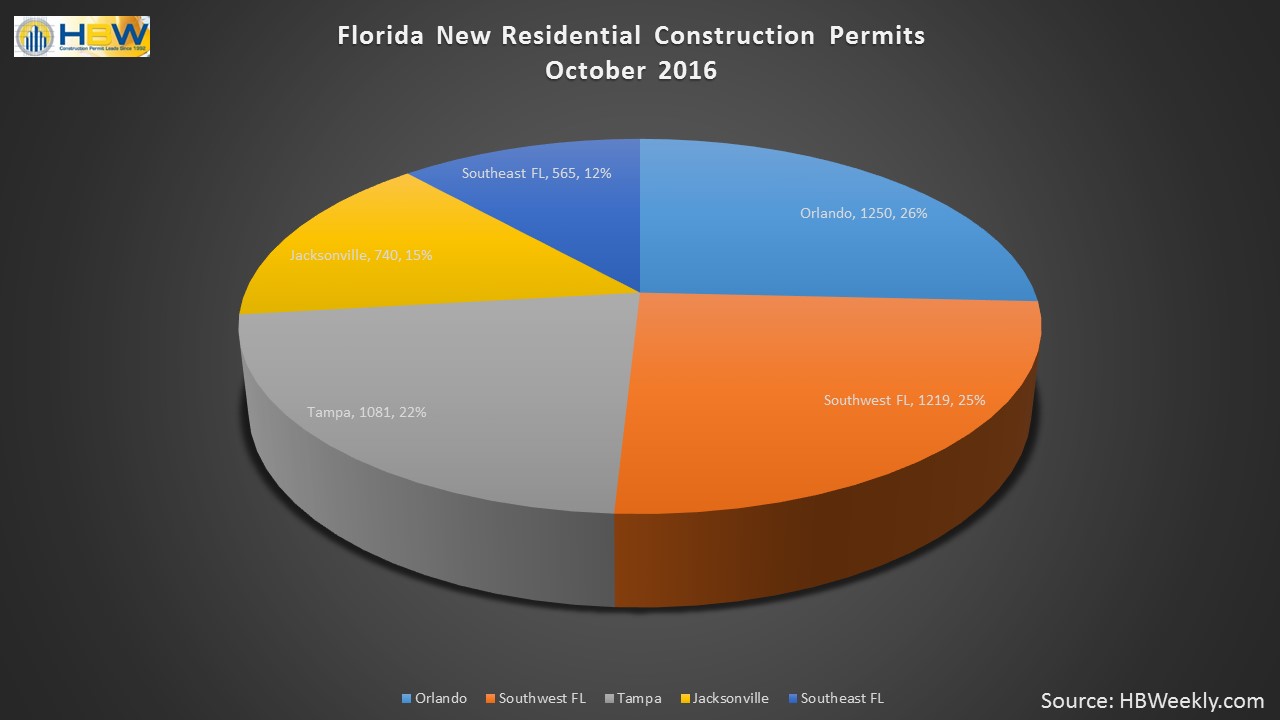
Out of more than 3,800 new permits in Florida that were added to the HBW database last month, approximately 27% were from the Orlando area.

hbweekly -- fl report

Opening the second quarter of 2016, Florida is looking good as the HBW database continues to grow with new permits and new leads.  Focusing on Orlando, Tampa, Jacksonville, Southeast and Southwest Florida, we found more than 3,800 housing starts on file for the Sunshine State and nearly $1.1 billion in total construction value.

FL Total Permits by Area - April 2016

FL Total Permits by Area – April 2016

In the center of it all (Central Florida), Orlando was #1 for total housing starts.  With 1,032 new permits and more than $294M in construction value, Central Florida is flourishing in new residential construction.  The average value of homes started in the area last month was $285,020, the second highest average in the state.  Orange County (the center of Orlando) was #1 in the state for total starts with 342 permits and close to $111M in total construction value.  Osceola County was the next highest for total housing starts in Central Florida with 260 new permits on file and a total construction value just over $43.8M.

The southwest region of Florida was not far behind Orlando with 960 housing starts in April and a total construction value in excess of $262M.  Four out of five of the counties reviewed in the southwest region made the top 10 list for total starts in Florida (see chart below).  New residential construction activity was somewhat evenly dispersed throughout Lee, Collier, Sarasota and Manatee counties.  Lee County took the lead in the area for total housing starts (240 permits), while Collier County was on top for total value of construction (~ $82.7M) last month.

Tampa was third highest last month for both total housing starts and average value of new residential construction. There were nearly 800 housing starts and more than $221M in new construction in the Tampa area last month.  The average value of homes started in April was $278,372, and the bulk of construction activity took place in Hillsborough County; Hillsborough had 319 starts last month and the highest total construction value in the area of more than $103.7M.  Polk County was second highest in activity with 202 new permits and a total construction value greater than $40.1M.

In Jacksonville, there were clearly two counties that dominated in new residential construction.  Out of the 669 housing starts and more than $168M in construction taking place in the Jacksonville area, Duval and St. Johns counties carried the bulk of the activity.  More than 242 housing starts with a total value in excess of $73.7M took place in St. Johns County last month.  Duval County was second highest in the area with 210 housing starts and a total construction value greater than $37.7M.

Finally, in the southeast region there were fewer total housing starts in comparison to other regions throughout the state.  With 368 new permits on file for the month, SE Florida made up for the lack of total starts by having the highest average construction value of any other area in the state (average value: $378,373).  Palm Beach County was #1 in the southeast for total housing starts (102 permits), while Miami-Dade County took the lead for highest total value of new construction (> $43M).

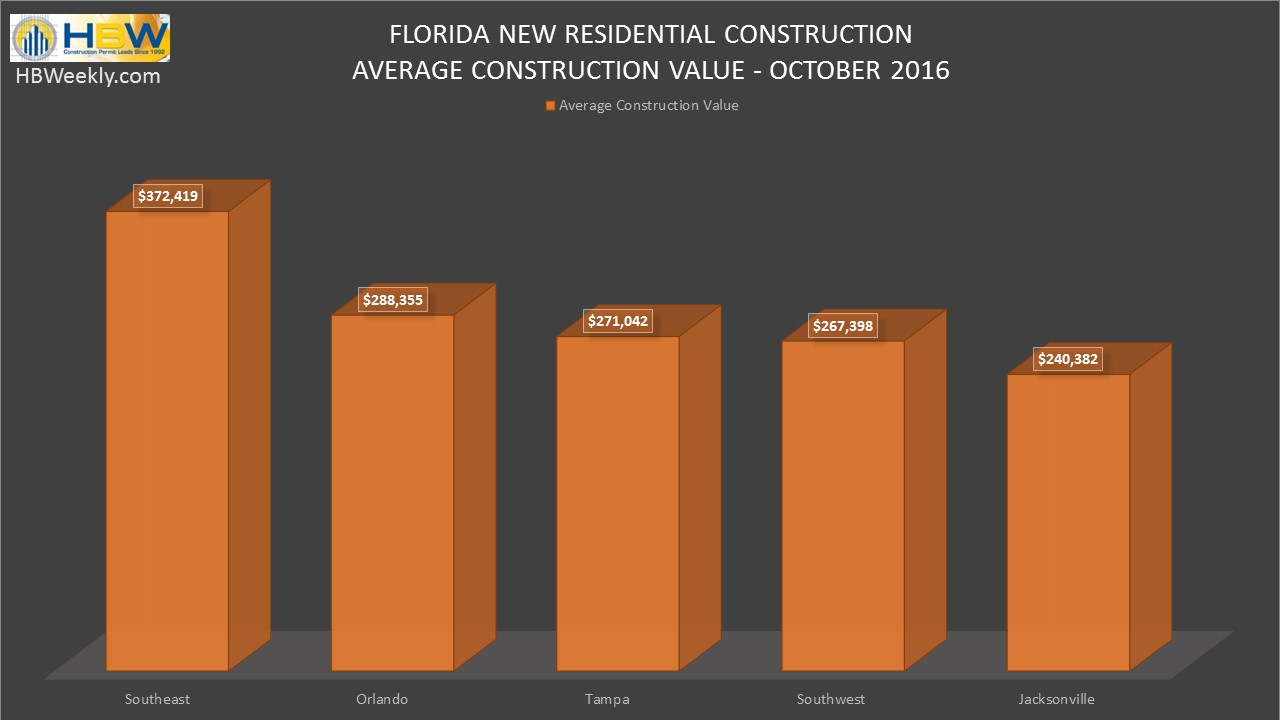
FL Average Value of Residential Construction - April 2016

FL Average Value of Residential Construction – April 2016

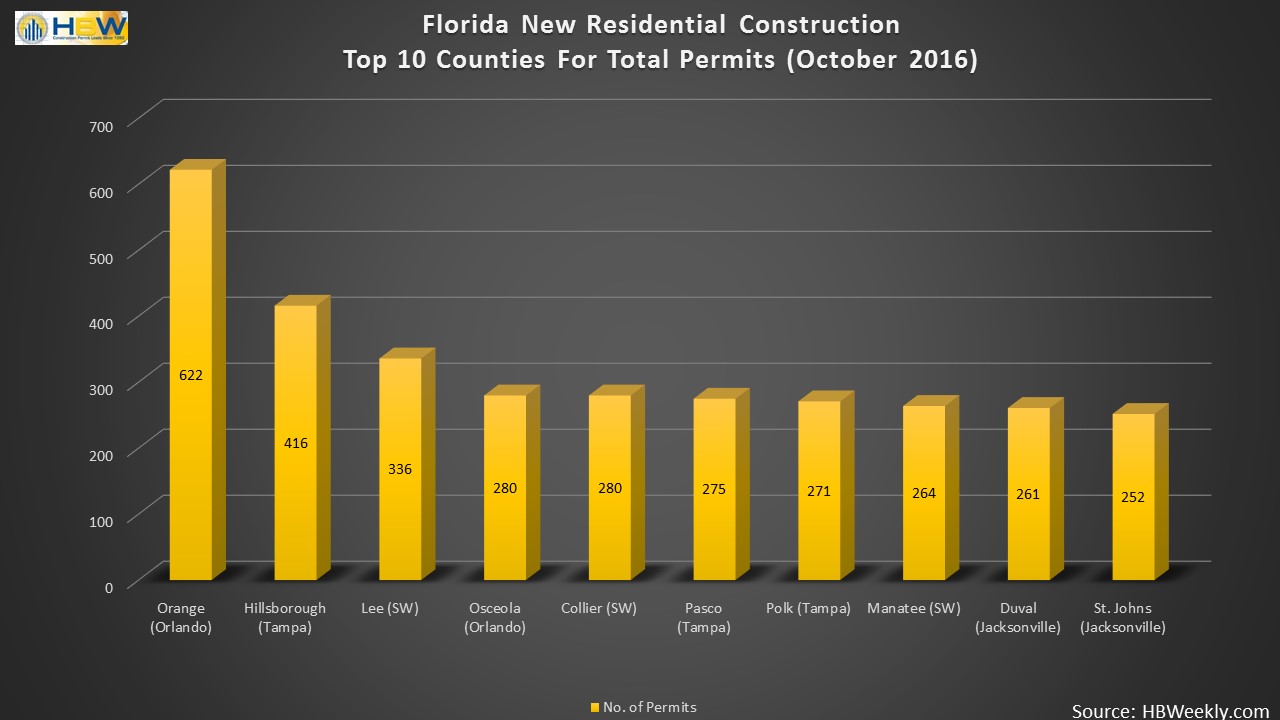
When comparing counties throughout Florida, Orlando’s Orange County was #1 for total housing starts in April (342 permits), while Tampa’s Hillsborough County came in at a close second with 319 new permits on file.  Here’s a closer look at the top 10 counties throughout the state for the month:

FL Top 10 Counties for Total New Resid. Permits - April 2016

FL Top 10 Counties for Total New Resid. Permits – April 2016

Information utilized for the graphs and above listed figures was directly derived from HBW construction data reports. To gain access to the HBW database and receive custom and detailed reports on the latest residential and commercial building activity in Florida, Georgia, Texas, Alabama, and Oklahoma, please contact HBW for details.

Texas Residential Construction Report – April 2016

tx hbw reports

The stats are in for April, and Texas residential construction held strong for the month with more than 5,000 new permits on file with HBW.  Out of the nearly $1.2 billion in new residential construction occurring in Houston, Dallas, San Antonio and Austin combined last month, Houston led with the most housing starts (2,020 permits), while Dallas experienced the greatest increase in starts since March (+8%).  Across the board, every metropolitan area reviewed was slightly ahead of totals for March, and overall, there was more than a 3% increase in housing starts from March to April.

Texas Residential Construction Permit Totals - April 2016

Texas Residential Construction Permit Totals – April 2016

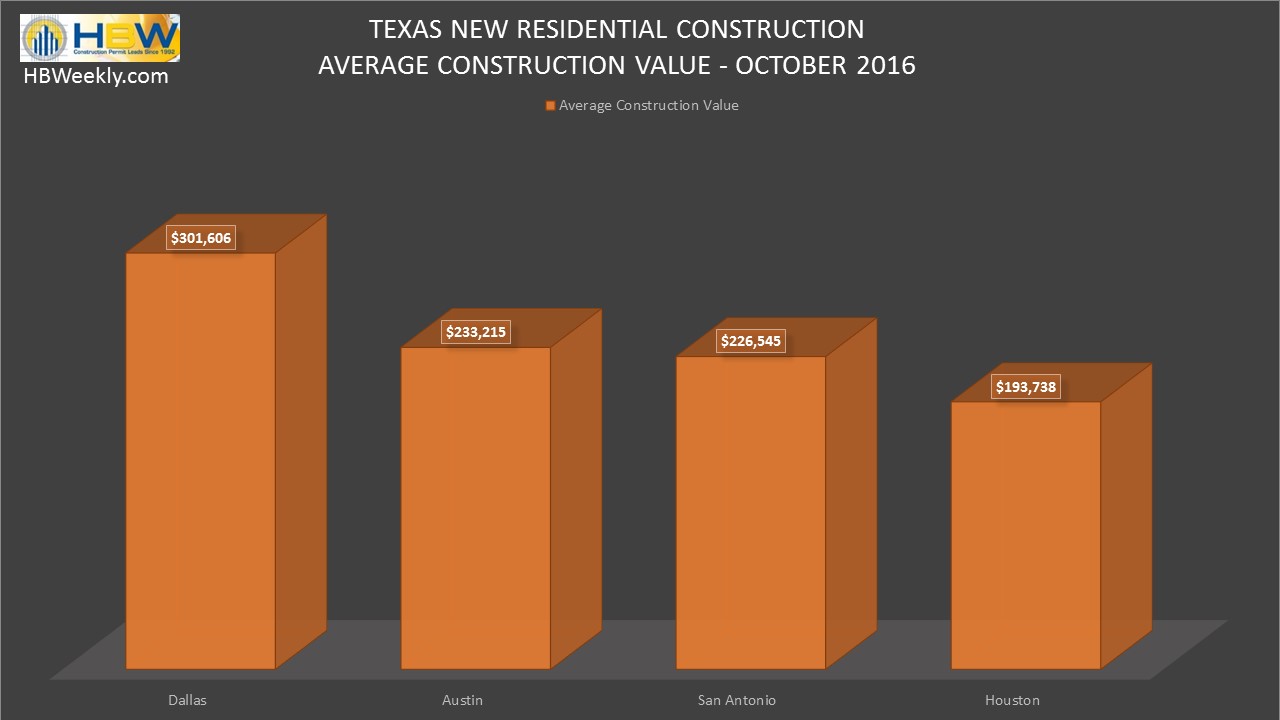
Earlier this month, Forbes reported on the nation’s top 10 hottest markets for 2016 (as per Zillow), and Dallas took the #1 spot. According to the report, the Dallas-Fort Worth area is expected to see home values increase by 5.6% this year (source: Forbes). Consistent with the Forbes report, Dallas is also on top in the HBW database for highest average value in residential construction (~$293k – April). Additionally, the total value of residential construction in the Dallas area was the highest out of the four areas reviewed with more than $498M in April.

Average Residential Construction Value (April 2016):

Dallas – $292,532

San Antonio – $240,971

Austin – $228,562

Houston – $190,515

On the other end of the spectrum of average construction value, we have Houston. Just a few weeks ago, the Houston Business Journal cited the slump in crude oil prices as the cause for a drop in Houston’s luxury home market.  According to the most recent data released by the Houston Association of Realtors, sales of homes valued at or above $500,000 dropped by 12.4% year over year in March.  Although demand for high-value custom homes has reportedly fallen in Houston, the area came out on top for total housing starts (2,020 permits) and was second highest for total construction value for the month (~$385M).

In Austin, new residential construction remained steady in comparison to March with just over a 1% increase in activity and a total construction value close to $207M.  Out of the 904 housing starts in Austin last month, more than half occurred in Travis County.

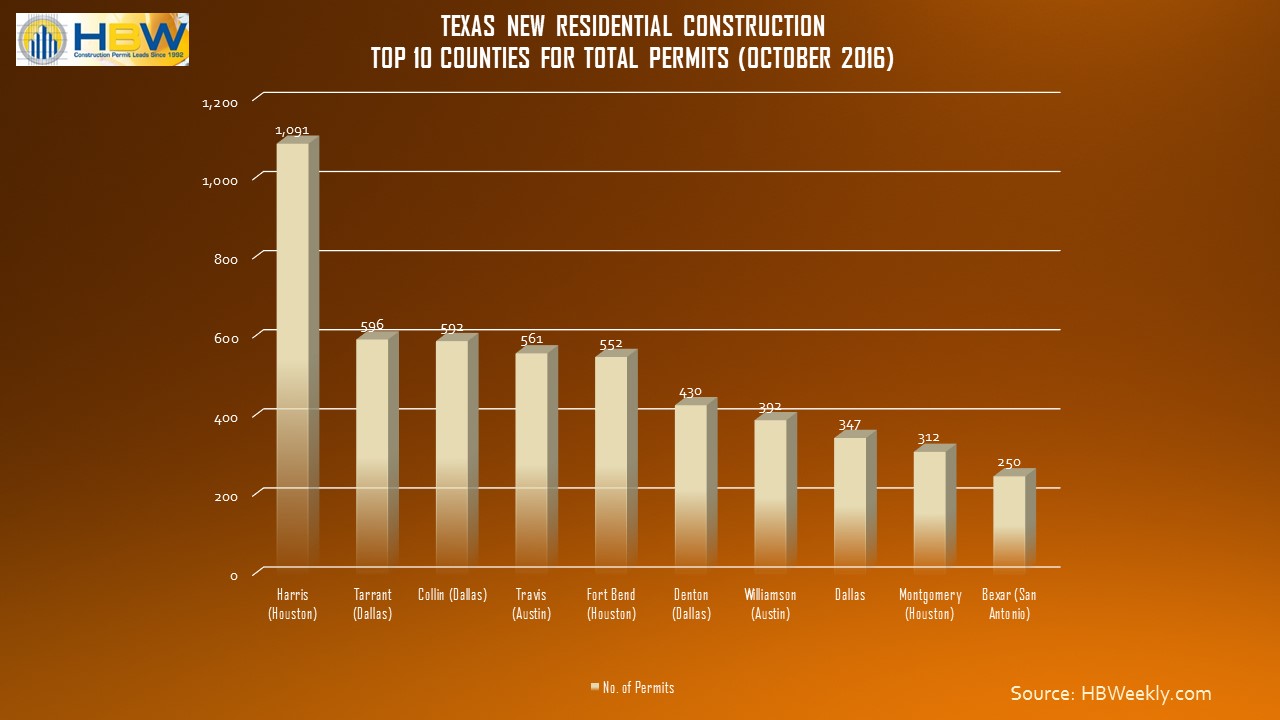
Finally, we took a look at San Antonio which had more than $106M in total construction value for the month.  Although the area had the least total new residential construction permits on file in April (441 permits), San Antonio was second highest for average value of residential construction (~$241k).  Nearly half of April’s new residential construction took place in Bexar County – Bexar also made the Top 10 list for total housing starts.

Texas Top 10 Counties for Total New Permits - April 2016

Texas Top 10 Counties for Total New Permits – April 2016

Information utilized for the graphs and above listed figures was directly derived from HBW construction data reports. To gain access to the HBW database and receive custom and detailed reports on the latest building activity in Texas and beyond, please contact HBW for details.

5 Tips for a Better Website

Just like home building, website design requires plenty of planning and maintenance to serve its purpose now and in the future.

w_edited

Whether you currently have a website or are looking to launch one, there are a few simple things to keep in mind to ensure you are getting the most out of your web presence.  Your website doesn’t only serve as a way to be found on the internet; it is one of the first places your HBW leads will look to learn more about your company and services.  Even if you have a website manager who handles the technical aspects of your site, you are most likely responsible for website content.  In addition to reflecting your brand, your website should be user-friendly, easy to navigate and provide the information that your target audience will be searching.  Here are five areas to review when building a new website or simply making “renovations” to your current one:

  1. Keep it Simple – Long gone are the days of lengthy “About” sections and a never-ending scrolling list of services. Consider this: The attention span of a human is only 8 seconds (source: The Telegraph), one second less than a goldfish, and our fast-paced digital world isn’t helping.  Thanks to smartphones, scrolling news feeds and our on demand lifestyles, there is simply not enough time in the day for a visitor to sift through mountains of text. For this reason, make your website simple, fresh and clean.  Your navigation bar should be free of clutter, and your contact information and social links should be obvious and easily accessible.
  2. Pay Attention to “Home” – Don’t neglect your “Home” page; it is the one page that most of your site visitors will see, and it serves as both an anchor and front door to your business online. A busy first page can be cumbersome to navigate and too time-consuming for the reader to get to any other page.  Think of a driveway and entryway to a home – the more cluttered and obstructed in design, the more challenging it will be to enter the home.  The same concept applies to your opening page.  The home page should consist of the essentials including a clear headline and sub-headline, main call-to-action, visible navigation bar, supporting image and key features and benefits.  Other important information like resources, testimonials and product and service details should be viewable through other pages and links, easy to locate and one-click away.
  3. Be Mobile – Almost every new website will have a mobile version, but what about the one you launched five years ago? If not up-to-date, it is possible that the site is not viewable from certain mobile devices.  Once you have a mobile version, you will want to test every page from both tablets and phones (ios and android).  The content should be formatted to fit a variety of screen sizes, and images should load properly.  Also, keep in mind that some viewers may still prefer the desktop version of your site, so offer the option to view the site on “Desktop Version” at the top and/or bottom of each page.
  4. Be Unique – Don’t limit your site by following a singular model. Although you should aim for simplicity in design, you still want to make a strong first impression.  Having a website that looks like everyone else, including your competition, offers less than a memorable experience for your visitors.  The more authentic your images and content, the better chance you have to stand out from the crowd.  Being unique can simply be attained by remaining true to your brand and offering images and videos that originate from your company.  Although stock images and video can be useful in some instances, when it comes to your website, your unique designs and offerings should be showcased in a framework and layout that is distinctive and reflective of your brand.
  5. Track it – This one gets overlooked time and time again. Many small businesses may check how many “likes” or “followers” they have on social media but fall short when it comes to website visitors.  It’s easy enough to gauge and analyze site visitor traffic by getting started with Google Analytics.  It is free and an important tool for monitoring visits and learning more about pages and content that are of interest to your audience.  It is also useful in tracking the impact of your marketing efforts including social media campaigns and any email marketing or other communications you may develop to reach your HBW leads.

Just like any home or property, a website requires upkeep and upgrades to stay current and in proper functioning order. Through appropriate maintenance and repair, your website will continue to have the curb appeal it needs to get the visits and prospects in the door.

For more information on construction business tips and industry updates, stay connected with the HBW Blog.  To get ahead of construction activity and gain access to the latest permitting data in Florida, Texas, Georgia, Alabama and Oklahoma, contact HBW for more information on construction data reports and industry leads.

Contractors Ask: What About Snapchat?

Image source: Snapchat.com

Image source: Snapchat.com

Think that Snapchat is just a fad for teens?  Think again.  What started out as an easy video story and messaging app for teens and millennials has become a surprisingly useful and growing tool for marketers.  According to a recent article by Bloomberg, Snapchat’s use is rapidly growing, with more than 10 billion video views and 100 million users each day.  Even more impressive is that the number of views is up from 8 billion since February – Now that’s growth that will certainly garner attention.

As a construction professional, you may or may not have considered using Snapchat at this point, but if the unmistakable and instant growth hasn’t sparked your interest, consider the major powerhouse companies using the app.  Netflix already being in the business of video is an obvious match for the app, successfully using it to provide sneak peeks of upcoming movies and series.  At the same time, you have leading corporations like AT&T, McDonald’s, Amazon, Audi and many more that have hopped aboard the Snapchat train to share their brand and start conversations.

Snapchat is no longer just about photos that disappear in 10 seconds – Unlike most social media apps that serve as a repository for images and videos, Snapchat offers the convenience and fluidity of quick messaging as well as posts that can remain for 24 hours.  The basic idea of Snapchat is that it enables the user to seamlessly transition between different styles of “chat” from video, audio, text, photos and drawings; it is face-to-face conversation amplified.  The app makes it possible for private conversations to shift between mediums, enabling the user to customize the experience and maximize the conversation.

For home builders, the app can be useful in a variety of ways.  Snapchat users can send messages to an individual or groups of people while chatting which can be effective when sharing related projects and designs to prospects and clients.  Additionally, if you are on a video call, you can send images as an overlay so that the designs being discussed can be viewed simultaneously by the other party.  As part of your marketing strategy, Snapchat can be useful in the following:

  • Spotlight an Event – Whether you are participating in a tradeshow or having a community or charity event, Snapchat provides your audience with a front-row seat even if they can’t actually be there.
  • Social Incentives – Just as with any social media platform, contests and incentives that are communicated through Snapchat have the potential to engage your audience and get them “in the door”. You may also offer discounts and promo codes to fans.
  • Behind the Scenes – Prospective clients want to see proof in your work, and moving beyond one-line testimonials, Snapchat provides authentic and real evidence of your work and professionalism. By taking viewers inside a renovation project or providing a first-hand look into the design process, they can get to know you and your business in a new and personal way.
  • Product Launch – If you have a new product or service, you may use Snapchat to build buzz and interest with sneak peeks and teaser videos.


Just as with any new marketing tool, you will want to take your entire marketing strategy into account before jumping into Snapchat with both feet.  It should complement your current efforts, and messages should be aligned with your brand and have a clear objective. Consider your target audience and primary client base to assess if it is the right tool for reaching them.  Although you may want to save the personal pics and “stickers” (cartoons/emojis) for the teens, a high-quality video of on-site progress or photo of your latest remodel may be the way to start, or close, a conversation with a future client.

For more information on construction business tips and industry updates, stay connected with the HBW Blog.  To get ahead of construction activity and gain access to the latest permitting data in Florida, Texas, Georgia, Alabama and Oklahoma, contact HBW for more information on construction data reports and industry leads.
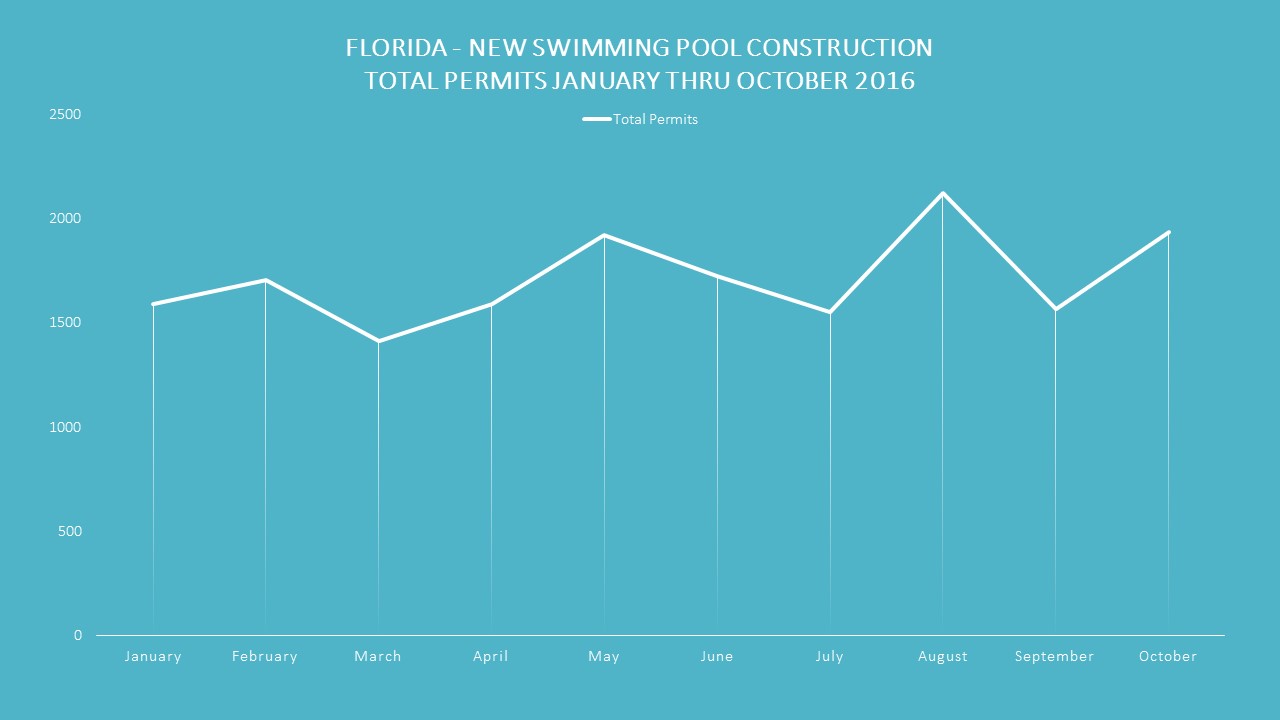
HBW Report: Florida Swimming Pool Construction

In the first quarter of 2016, more than 4,700 new swimming pool construction permits were added to the HBW database for Florida.

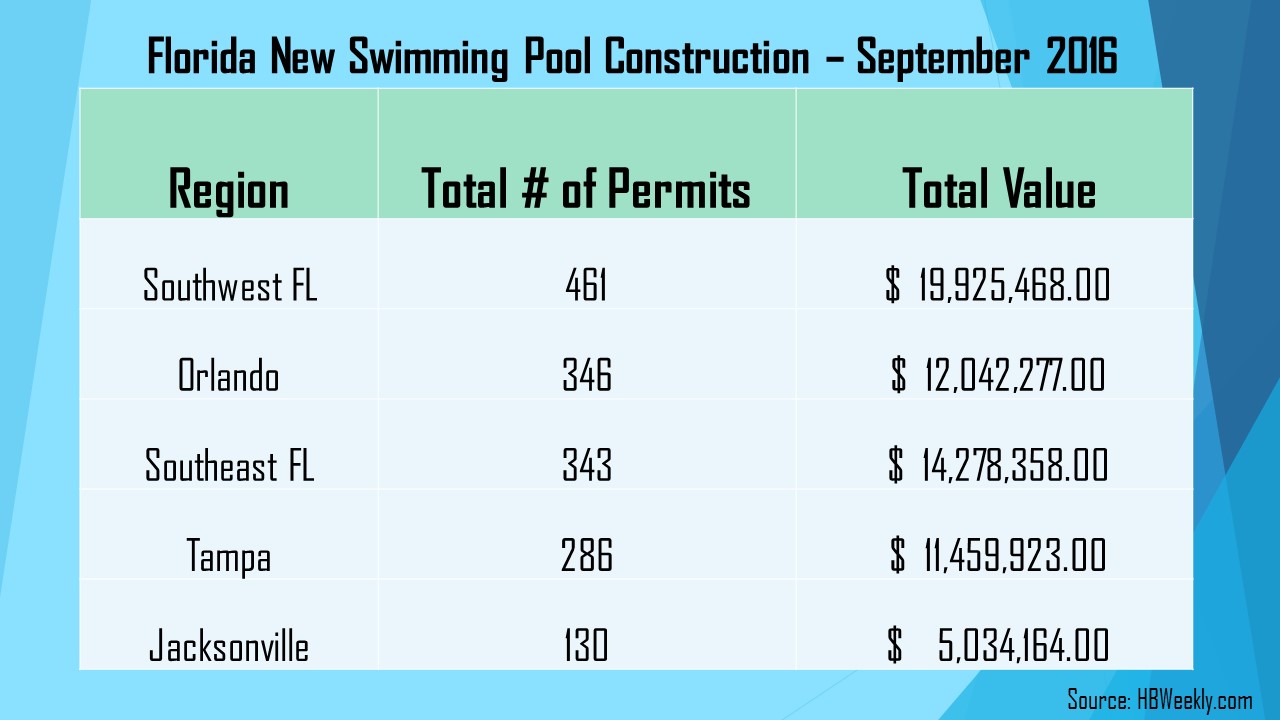
Each month, we have a chance to review the latest figures and reports from HBW, gaining valuable insight on residential and commercial construction. At the closing of the first quarter of 2016, we gathered the latest data to review new swimming pool construction in Florida.  In Q1, there were 4,713 pool construction starts throughout the Sunshine State with a total construction value exceeding $194M.

The southwest region was in the lead for total new permits on file with 1,491 pool starts and nearly $61.5M in total construction value.  Southeast Florida was also busy in the first part of the year with 1,032 new pool construction permits and more than $44.5M in total value.  Central Florida (Orlando area) was third highest for total new permits with 980 starts and close to $35M in total construction value.

Florida Pool Permits by Area (Q1 2016)

Florida Swimming Pool Permit Totals – Q1 2016

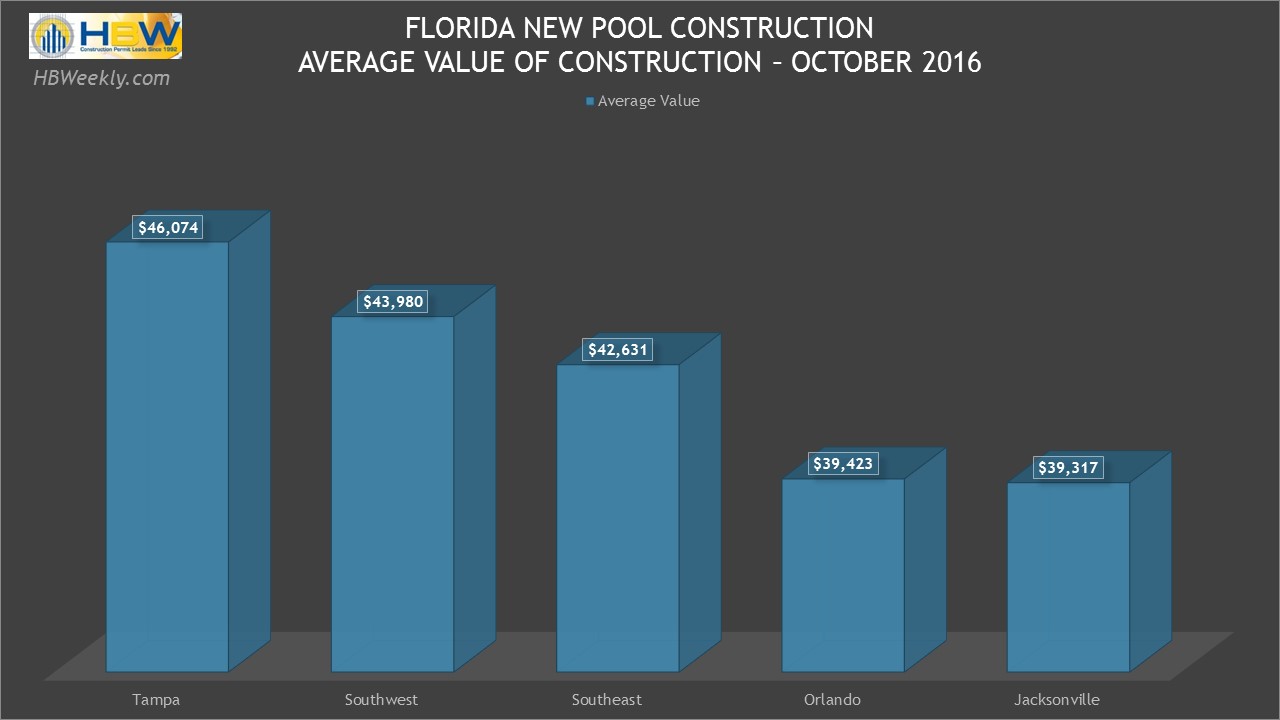
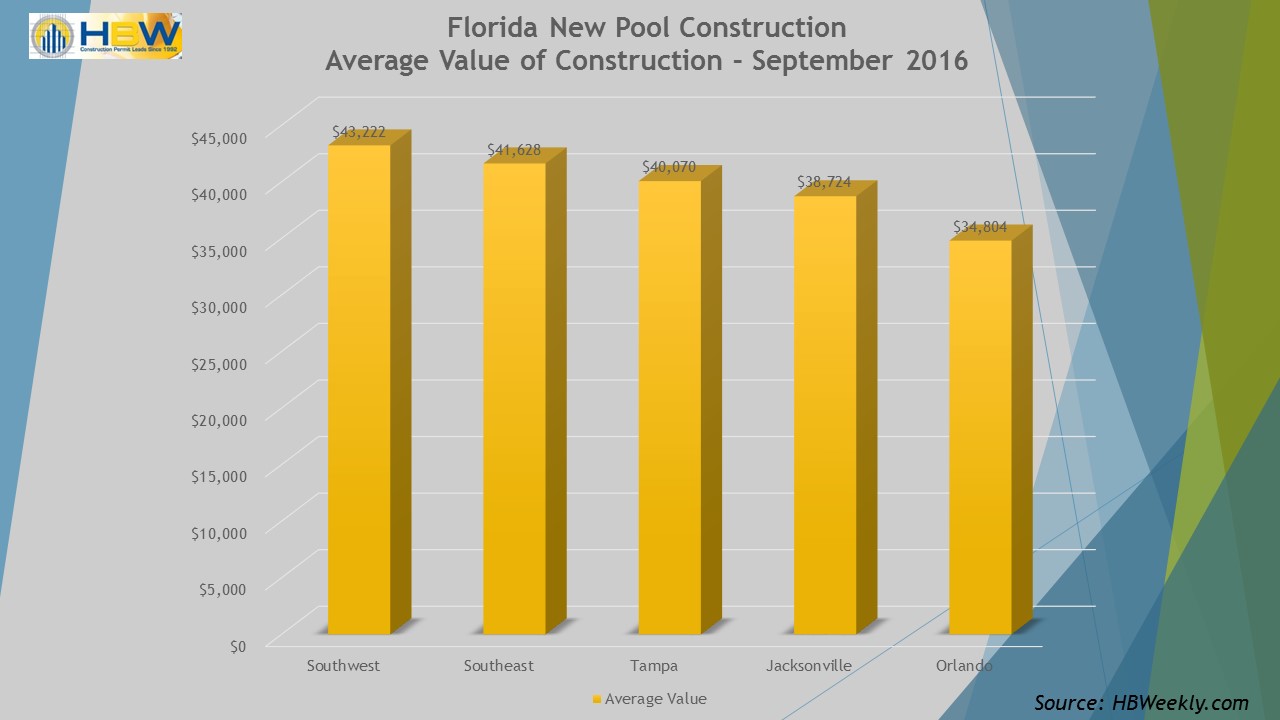
From Jacksonville, Tampa, Orlando and the southeast and southwest corners of the state, the average value of pool construction varied.  Jacksonville was on top with the highest average value of more than $51k, while the Orlando area held the lowest average value ($35,593) for new swimming pool construction.

FL Average Pool Construction Value - Q1 2016

FL Average Pool Construction Value – Q1 2016

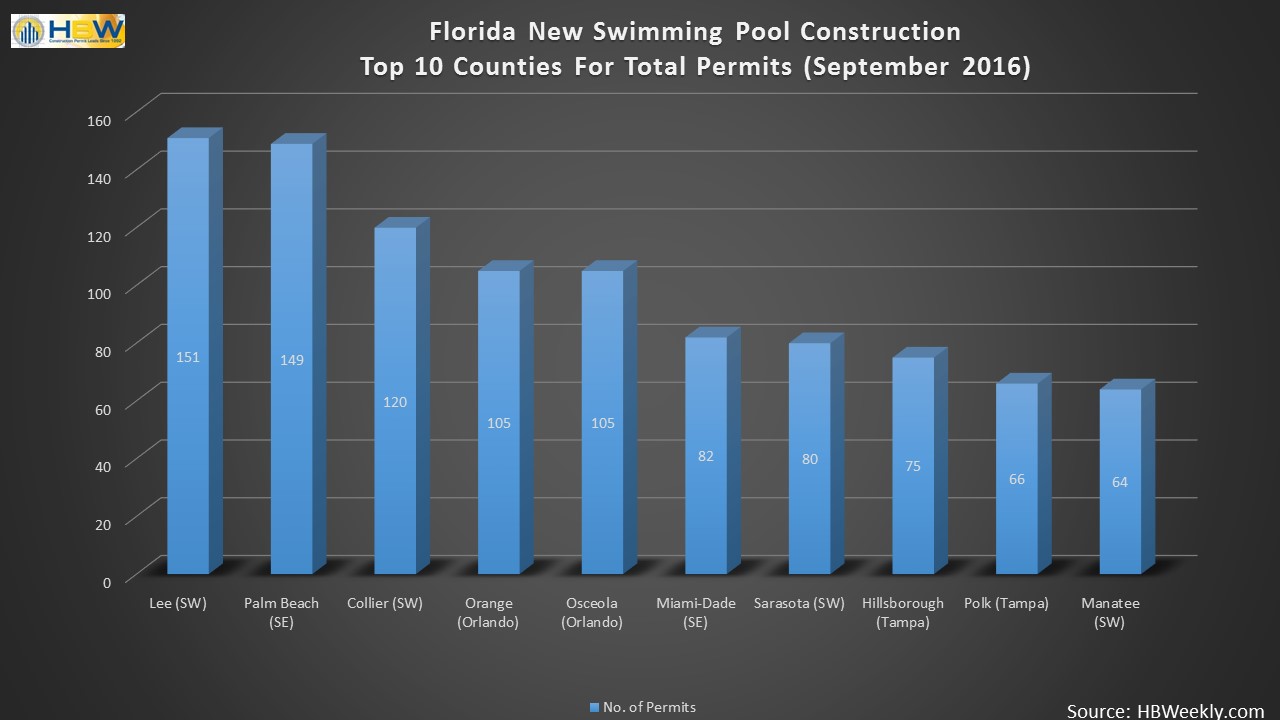
When taking a look at the counties with the most new swimming pool construction activity, the southwest region holds three out of five spots on the top five list.  Lee County (SW) had the most new permits on file in Q1 with 438 pool starts and more than $18.6M in total construction value.  In the southeast, Palm Beach County was second highest for new swimming pool construction with 420 new permits on file and a total construction value of nearly $16.9M.  Collier County (SW) held on to third with 385 starts and nearly $16.8M in total value.  Orlando’s Orange County (344 permits) and the southwest region’s Manatee County were fourth and fifth highest for total new swimming pool construction permits in the first quarter.

FL Top 10 Counties for New Swimming Pool Permits - Q1 2016

FL Top 10 Counties for New Swimming Pool Permits – Q1 2016

Information utilized for the graphs and above listed figures was directly derived from HBW construction data reports. To gain access to the HBW database and receive custom and detailed reports on the latest residential and commercial building activity in Florida, Georgia, Texas, Alabama, and Oklahoma, please contact HBW for details.

Texas Top Home Builders – March 2016

With nearly 5,000 new residential construction permits on file with HBW for March, Texas home builders continue to take on new projects in the face of the oil slump.

TX New Permits by area - March 2016

Despite the oil and labor challenges, Texas home builders were responsible for nearly $1.25 billion in new residential construction in March. Although Dallas, San Antonio and Houston experienced slight dips in total new permits in comparison to February, Austin’s 27% increase in activity (vs. Feb. 2016) for the month has the Lone Star State seeing new residential construction totals consistent with figures from February.

As for home builders, the top three remained the same since February, with D.R. Horton continuing to hold the #1 spot for total housing starts in March.  According to the HBW database, D.R. Horton had nearly 550 housing starts on file for the month, and took the top spot in three out of four of the metropolitan areas reviewed. The top three builders across the state for total new permits are as follows:

#1. D.R. Horton

#2 Lennar Homes

#3 Pulte Homes

Although the leading builders statewide remained the same from February to March, in each area there are some new additions to the “Top 5” list.  Here’s a closer look at the breakdown in each area:

Houston

Earlier this month, Houston Business Journal reported that Houston is experiencing a slowing in residential construction due to the oil slump.  In the HBW database, Houston also saw a slowing (~ 11% decrease) in housing starts since February.  Despite this fluctuation, out of the four Texas areas reviewed, Houston had the most starts on file (2007 permits) for the month.  The home builder leading construction in the area was D.R. Horton, with 252 housing starts and nearly $29M in total construction value.  Although not in the “Top 5” last month, K. Hovnanian Homes held the second highest spot for total new permits on file with 141 housing starts and a total value in excess of $22.5M.  Previously holding the #2 spot in February, Lennar Homes tied K. Hovnanian with 141 housing starts in March and came close to total value with just over $22 million in residential construction.

Houston Top Home Builders by Permit Totals - March 2016

Houston Top Home Builders by Permit Totals – March 2016

Dallas
According to recent reports from the Dallas Business Journal, Dallas home builders are seeing “booming home sales” and an increase in residential construction in comparison to the same time last year.  Based on the latest HBW reports, Dallas home building is holding strong as the area was second for total housing starts in March. Out of the 1,579 new permits on file, D.R. Horton held its lead in Dallas with 134 housing starts and more than $28M in construction value.  Next in line for total starts and pushing up to the “Top 5” was First Texas Homes.  First Texas was second highest for total permits with 93 housing starts.  The home builder also took the #1 spot for total construction value in the area with nearly $29.3M in new residential construction in March.  Dropping from #2 in February to #3 in March is Pulte Homes; Pulte Homes had 88 housing starts for the month with a total construction value of more than $20.4M.

Dallas Top Home Builders by Permit Totals - March 2016

Dallas Top Home Builders by Permit Totals – March 2016

Austin

As previously mentioned, the Austin area saw a 27% spike in housing starts in comparison to February. D.R. Horton led the Austin area for housing starts in March with 154 new residential construction permits on file for the month and a total construction value close to $22.8M.  Up two spots from #4 in February, Lennar Homes ranked second highest for total permits in the area with 59 housing starts and a total value in excess of $6.4M. Dropping one spot to #3, KB Homes has 51 housing starts on file for March and a total construction value of more than $7.7M.

Austin Top Home Builders by Permit Totals - March 2016

Austin Top Home Builders by Permit Totals – March 2016

San Antonio

In San Antonio, Continental Homes continued to hold the #1 spot for total new residential construction permits.  The home builder is responsible for more than 20% of the new residential activity in the area for March, with 86 housing starts on file and a total value of more than $18.5M.  Also consistent with February, KB Homes held on to the #2 spot with 26 housing starts and a total value of nearly $6.3M.  Just behind KB Homes was Chesmar Homes.  Chesmar Homes jumped one spot since February to #3 with 25 starts and a total construction value close to $7.3M.

San Antonio Top Home Builders by Permit Totals - March 2016

San Antonio Top Home Builders by Permit Totals – March 2016

Information utilized for the graphs and above listed figures was directly derived from HBW construction data reports. To gain access to the HBW database and receive custom and detailed reports on the latest building activity in Texas and beyond, please contact HBW for details.

10 Ways to a More Sustainable Home

It’s Earth Day and a perfect time to explore ways to meet the demand and need for more sustainable living.

Image by: freepik.com

Image by: freepik.com

Happy Earth Day!  Today is a great time to look at energy-saving products and services you can offer your clients to assist them in reducing their carbon footprint.  Home builders are well aware of the benefits of green building programs, meeting green standards through regional programs, LEED-certified buildings and Energy Star.  With climate change, excessive droughts and unstable fuel prices, there is no denying that green building is gaining demand and ground in the industry.

Along with the obvious and necessary shift to sustainable lifestyles, commercial buildings and homes are being designed with sustainability at the forefront.  According to AIA’s latest survey of architects on expectations for nonresidential design trends, sustainability, project efficiency and new technologies topped the list of priorities (source: AIA).  As for residential demand, 33 million homeowners are planning for home renovations this year, with exterior renovations (pools, landscaping, decks, driveways) being the most popular. (source: Bankrate.com).  With the expected renovations coming down the pipe, it provides a great opportunity to upgrade residential projects with earth-friendly designs and technology.  For this reason, we will explore easy upgrades and fixes that you may offer to current clients to save energy, money and ultimately be more sustainable and environmentally-friendly.

  1. Use the Sun – Beyond solar pool heaters, there are countless ways to use the sun’s energy to make a home more energy efficient. Sky lights are one way to add extra light and warmth to the home while reducing heating and lighting costs. Other solar upgrades include: Solar outdoor lighting with LED bulbs that automatically turn on at dusk; solar water heaters; and solar panels to power the home.  On average, homeowners can save over $1,000/year by using solar panels (source: SolarEnergy.net), which is a plus along with saving energy.
  2. Maximize Landscape – Your clients want beautiful yards, but have they considered tasty yards? Although they may have some neighborhood critters to contend with, adding edible plants such as cabbage, fruit and nut trees are a great way to spruce up the yard and make a shift to organic gardening.  Also being strategic with planting trees can cut summer cooling bills by adding shade to the home.  To allow for more light during the winter months, plant the trees on the west and east sides of the home.  As for keeping the gardens and shrubbery hydrated, there may be the capacity to store rainwater by use of a rainwater cistern.
  3. Choose a Paint – When painting the interior walls of a home, consider offering paints that are low in volatile organic compounds (VOCs). Your client may appreciate the effort in reducing their exposure to harmful chemicals found in many paints and stains.
  4. Raise the Roof – Roof insulation is one way to save energy, but also consider offering a variety of choices in building materials. Check with your suppliers on their latest products that are developed with eco-friendly methods as well as with a function for energy savings. You can educate your clients about color choices as well; the color of the shingles they choose can play a role in the home’s energy efficiency. Encourage clients to use the sun to their advantage by choosing lighter colors in warmer climates (reducing heat) and darker shingles in cooler climates (melting snow).
  5. Change Lighting – Along with solar lighting mentioned above, using compact fluorescent light bulbs (CFL) can save up to $30 in energy cost per life of the bulb; additionally, if every U.S. household replaced one bulb with a CFL, it would prevent enough pollution to be equivalent to removing 1 million cars from the road (source: inhabit.com). Another way to add more efficient lighting would be to install motion-sensing switches that automatically turn off the lights when the room is empty.
  6. Build Up – When possible. This one is a great selling point for home builders.  When making additions, consider building up and instead of out.  By building an extra unit on top of a garage, or converting a home into a duplex or tri-plex, there will be less open space sacrificed to new construction.
  7. Smart Home – Thermostat sensors, light sensors and outside motion sensors do not only save energy and money, but they save time. Through light and thermostat upgrades, your clients can easily program their homes to manage the indoor temperature and lights without having to make daily adjustments or even being in the home.  With many systems offering remote access, home owners can set their systems for energy savings when they are out-of-town.
  8. Upgrade Appliances – From kitchen appliances to higher SEER air conditioning units, there are plenty of savings to be had in new appliances. Along with Energy Star certified products, there are smarter designs, like front-loading washers that use half the water and detergent of top-loaders. According to Energy.gov, home appliances account for approximately 13% of a household’s energy expense. By changing to products with higher efficiency ratings, your clients could save on up to 13% of their household energy use.
  9. Upgrade Bathroom – Along with faucet aerators that almost anyone can add to sinks, there are upgrades that can be made to toilets and showers. By installing low-flow shower heads, there is less water to heat, saving both water and energy.  Also, leaky pipes can go undetected for years, so a quick review of plumbing may be needed; even small leaks can waste thousands of gallons of water every year.  Low-flush toilets are also useful as they can reduce water use from six gallons per flush to one and a half gallons.
  10. Windows and Doors – Are the windows tinted? Properly sealed? Energy-efficient windows and upgrades are a great way to save energy and money for your client.  From sealing air leaks to adding insulation, you could cut their energy bill by 5%-30% (source: energy.gov).  Depending on the condition of the home, it may be as simple as caulking and using weatherstripping or as extensive as insulating walls and ceilings.

When it comes down to it, going green is a wide topic that can be addressed from the design and development phases to building and property maintenance.  By taking simple steps and offering the latest in sustainable products and services, you can meet your clients’ and the environment’s demand for sustainability, making earth day a reality every day.

For more information on construction business tips and industry updates, stay connected with the HBW Blog.  To get ahead of construction activity and gain access to the latest permitting data in Florida, Texas, Georgia, Alabama and Oklahoma, contact HBW for more information on construction data reports and industry leads.

Florida Quarterly Residential Construction Review – First Quarter 2016

More than 15,700 housing starts are on file with HBW for Florida, reflecting a 34% increase in new residential construction in comparison to the first quarter of last year.

Image Copyright: CarruthPhoto.com

Image courtesy of CarruthPhoto.com

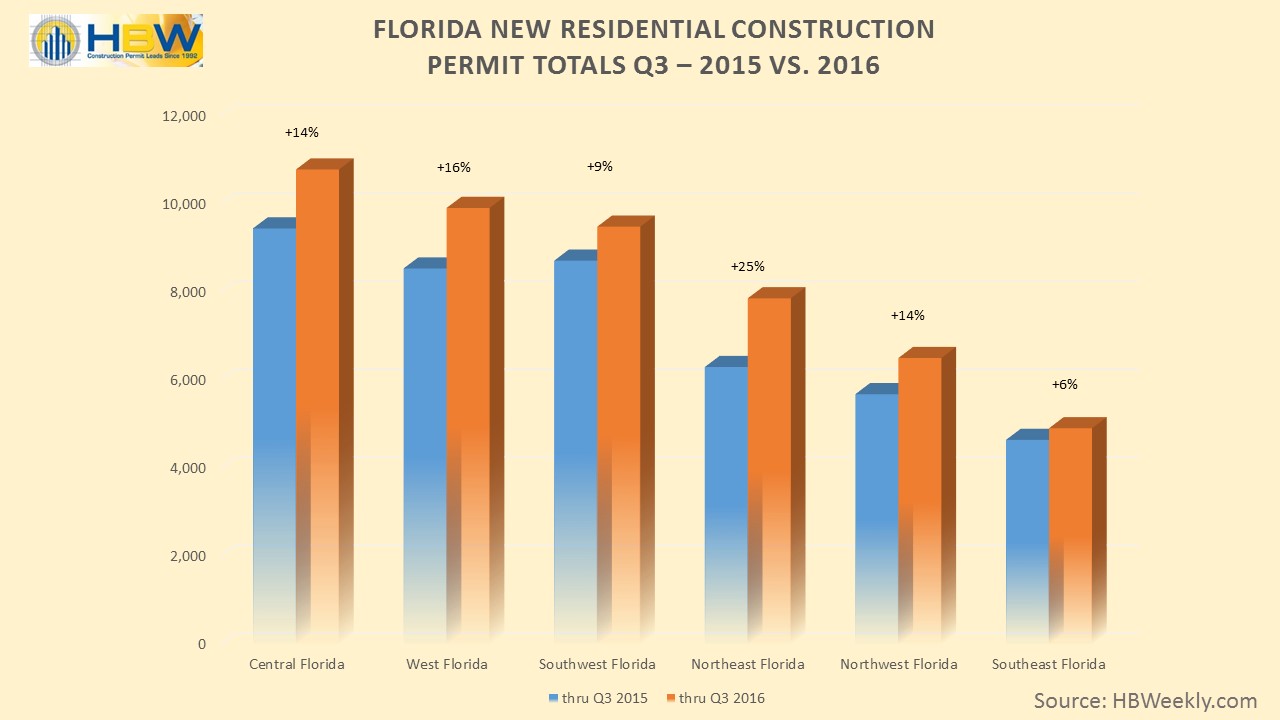
A recent article in U.S. News highlighted the top 20 most desirable places to live in the U.S.  Not surprisingly, 25% (5 cities) of the top locations were in Florida.  When looking at the latest HBW residential construction reports for the first quarter of 2016, Florida continues to shine with 15,745 housing starts on file and a 34% increase (vs. Q1 2015) in new residential construction.

Florida New Residential Construction Permits Q1 (2015 vs. 2016)

Florida New Residential Construction Permits Q1 (2015 vs. 2016)

Central Florida is at the top for total new residential construction permits in the first quarter. The area has 3,249 housing starts on file for this period, a 29.3% increase in comparison to Q1 2015.   Orlando is definitely on the rise in Central Florida; the city was listed at #16 by U.S. News as one of the top 20 most desired places to live.  In Q1, Orlando (Orange County) was #1 in the HBW database for total housing starts.  With 1,400 starts on file for the quarter, the county has experienced a 34% increase in new residential construction (vs. 2015).

Southwest Florida is also strong at the start of this year with 3,207 housing starts in Q1, a 54.6% increase in comparison to 2015.  Additionally, two cities in this region were identified as top places to live in the previously referenced report by U.S. News… Sarasota (#13 – U.S. News) and Fort Myers (#17 – U.S. News) both experienced more than 50% growth in residential construction in the first quarter of 2016.  The southwest counties of Lee, Collier, Manatee and Sarasota all held spots on the HBW list of top 10 counties for total housing starts in Q1.  As for growth, the southwest county of Charlotte was #1 in the state for growth with a nearly 153% increase in new residential construction over Q1 of last year.

As for total permits, the top three counties were spread across the state in Central, West and Northeast Florida.  As previously mentioned, Orange County took the lead statewide.  Just a short road trip from Orange County is Hillsborough County (Tampa).  Along with Tampa being listed as the #12 top desired town to live in the U.S. (source: U.S. News), it is the second highest for total housing starts.  With 926 starts on file for this period, Hillsborough County experienced more than a 32% increase in residential construction in comparison to Q1 2015.  Just behind Tampa and in the third spot with 894 housing starts, we have St. Johns County. St. Johns is another area experiencing substantial growth with a nearly 45% increase in new residential construction permits on file (vs. Q1 2015).  Here’s a closer look at the top counties for total housing starts in the first quarter of this year:

Florida 10 Top Counties for Total Residential Permits - Q1 2016

Florida 10 Top Counties for Total Residential Permits – Q1 2016

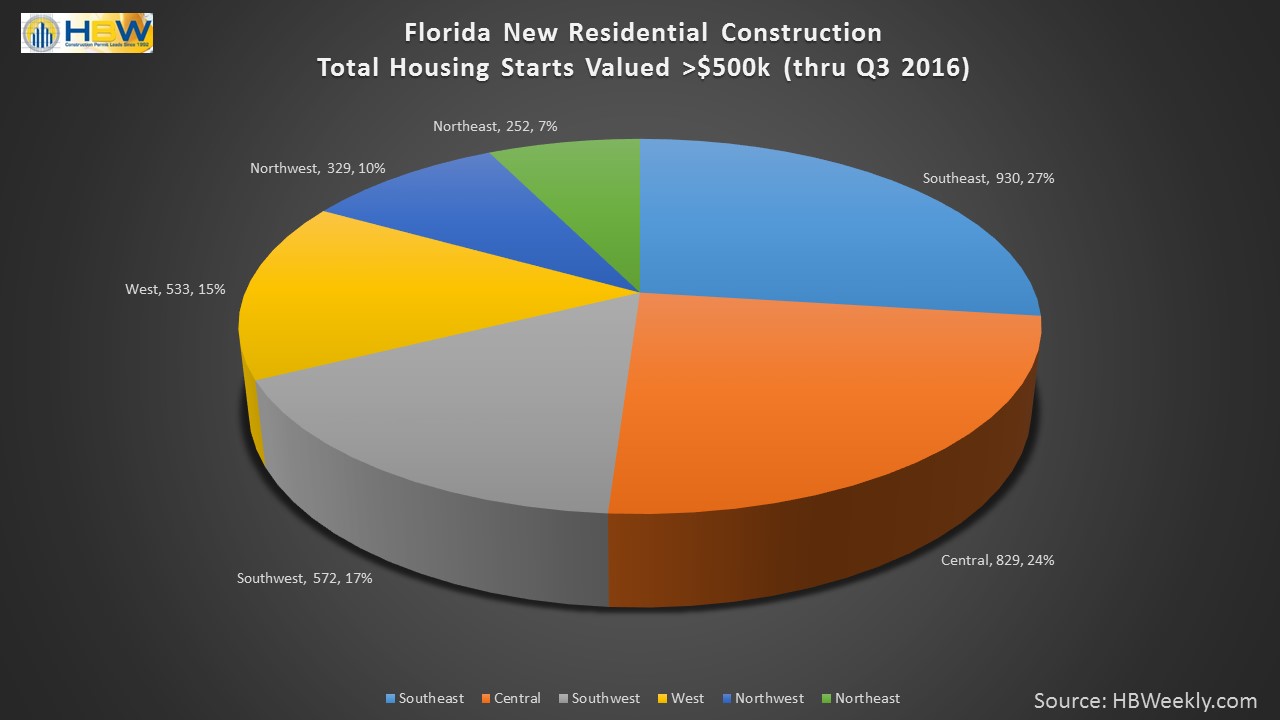
Earlier this week, Realtor.com identified America’s “Boom Towns”.  Boom Towns are areas that are well, booming.  According to the report, Miami (zip code: 33132) is expected to see households grow by 14.9% over the next five years. In just the first quarter of this year, and based on the latest from HBW, Miami-Dade County has seen a 60% increase in housing starts in comparison to the same time last year.  Although not in our top ten counties this quarter for total new permits, Miami-Dade is the #1 county in Southeast Florida and second highest statewide for new homes valued over $500k.  Other areas that are seeing the most new residential construction valued greater than $500k are Orange County (#1) and Palm Beach County (#3).  Across the state, in Q1 of this year there have been nearly 1,200 housing starts for homes of higher value (>$500k), making up approximately 7.5% of new residential construction permits on file for Florida this period.

FL Total Residential Permits for Homes > $500k - Q1 2016

FL Residential Permits for Homes > $500k – Q1 2016

Information utilized for the graphs and above listed figures was directly derived from HBW construction data reports. To gain access to the HBW database and receive custom and detailed reports on the latest building activity in Florida, Georgia, Texas, Alabama, and Oklahoma, please contact HBW for details.

Metro Atlanta – Quarterly Home Building Report

In the first quarter of 2016, the Metro Atlanta area is solid with a 32% increase in housing starts in comparison to Q1 2015.

ATL - HBWeekly.com


Metro Atlanta is having a great start to 2016 when it comes to residential construction.  Just last month, the Atlanta Business Chronicle reported that Metro Atlanta’s home prices are growing every year.  Based on a recent S&P/Case-Shiller Home Price Indices, home prices were reported to be up 5.7% year over year which is higher than the national growth rate.  Along with home prices, new residential construction activity also increased in the first quarter of the year.  According to the latest HBW permit report, there are more than 5,000 new residential construction permits on file for Q1 in the Atlanta area, a 32% increase from the same time last year; of the 5,017 housing starts on file with HBW, approximately 4% of them represent homes valued over $500k.

The counties with the greatest amount of growth in comparison to the same time last year include: Bartow (+300%); Clayton (200%); Dawson (167%); and Walton (161%).  Although these counties show massive growth in the first quarter, the number of total housing starts are slim in comparison to other counties in Metro Atlanta.

Counties with the highest concentration of new residential construction, and therefore the most new permits on file with HBW, also reflect growth for the start of the year.  Taking a look at Gwinnett County, there was a marked increase in new residential construction of 24% in comparison to Q1 2015.  With 881 housing starts in the first quarter of 2016, Gwinnett holds the top spot for total new residential construction permits in Metro Atlanta.  Forsyth County was close behind and second highest with nearly 800 housing starts – a 30% increase in comparison to the same time last year.  Next in line is Fulton County, and although Fulton County is in third with 500 housing starts, it is the county with the most new homes valued over $500k.  Nearly 17% of the starts in Fulton are for higher value (>$500k) homes, and overall the area has experienced a 24% increase in new residential construction over Q1 of last year.

Just behind Fulton County and in the fourth top spot is Cherokee County.  Cherokee County is up 59% (vs. Q1 2015) with 476 housing starts on file.  Finally, the county holding in at fifth for total new residential permits also saw the greatest amount of growth in the top five.  In the first quarter of this year, Dekalb County experienced an astounding 95% increase in comparison to Q1 of last year with 337 housing starts.  Over the past five years, Dekalb has consistently reflected huge leaps in residential construction activity, with the percentage of growth doubling year after year.

Metro ATL Top 5 Counties for Total Permits - Q1 2015 vs. 2016

Metro Atlanta Top 5 Counties for Total Permits – Q1 2015 vs. 2016

Information utilized for the graphs and above listed figures was directly derived from HBW construction data reports. To gain access to the HBW database and receive custom and detailed reports on the latest building activity in Georgia, Florida, Texas, Alabama, and Oklahoma, please contact HBW for details.

Texas Residential Construction Quarterly Report

With the closing of the first quarter, here’s a look at the highs and lows of residential construction in Texas.

tx


HBW subscribers working with leads in Texas are already aware of the more than 15,000 new residential construction permits on file in the first quarter of 2016.  From Dallas, Houston, San Antonio and Austin, there was about a 2% drop in activity in comparison to Q1 2015, yet areas like Dallas and Austin were on the rise with increases in housing starts of 12% in Dallas and 20% in Austin.

According to the latest report in Dallas Business Journal, home sales in Dallas-Fort Worth are up 22% year-over-year in the first quarter of 2016. The same article attributed the strength in the market to more favorable weather conditions in comparison to 2015, noting that the figures could be even higher if the labor shortage wasn’t still an issue in the industry.

When reviewing HBW’s latest Building Trend Report for new residential construction, the increase in housing starts was evident in the Dallas area with more than 4,700 new permits on file in the first quarter (up 12% in comparison to Q1 2015); just over 10% (500 homes) of the housing starts in Dallas were for homes valued over $500k.

The greatest number of housing starts on file was found in the Houston area, with more than 6,600 new residential permits in the first quarter.  Although the area saw a 16% decrease overall in new residential construction in comparison to the same time last year, the County of Brazoria experienced a massive 89% increase in housing starts.  The area also reflected more affordable housing as less than 3% of new residential construction was for homes with values in excess of $500k.

As previously mentioned, Austin was up in the first quarter with a 20% increase and more than 2,400 housing starts.  The majority of new residential construction took place in Travis and Williamson counties, and approximately 5% of new homes were valued greater than $500k.  Just behind Austin was the San Antonio area with nearly 1,500 housing starts.  San Antonio experienced a 5% increase in activity in comparison to Q1 of 2015, and less than 3% of new residential construction was for homes valued over $500k.

Texas New Residential Construction Permits – Q1 2015 vs. 2016

Texas New Residential Construction Permits – Q1 2015 vs. 2016

Taking a look at the counties with the highest concentration of housing starts in the first quarter, there are areas in Houston, Dallas and Austin that take the lead.  Harris County (Houston) was #1 for total starts with 3,303 new residential construction permits on file.  Harris County was also one of the top areas (third highest) for total starts of homes valued over $500k (102 homes). In Dallas, Collin County was second highest in the state with 1,514 housing starts, an increase of 14% in comparison to Q1 2015. Collin County was also second highest for homes valued over $500k as more than 7% of starts (113 homes) were in the higher value bracket.  In the third spot, we look back at Houston and the county of Fort Bend.  Although Fort Bend was third highest for total starts (1,434 permits), it had a 27% decrease in total new permits in comparison to Q1 2015.  Of course, this is just the first quarter, and since 2011, Fort Bend has consistently had a pattern of growth in new residential construction year after year.

Two other areas that have continued a pattern of growth over the last five years are Travis County (Austin) and Tarrant County (Dallas).  Travis County is already on the upswing in the first quarter of 2016 with a 33% increase in comparison to Q1 2015 and 1,325 new residential construction permits on file.  Tarrant County (Dallas) was fifth highest for total housing starts with 1,153 new permits on file in Q1.

Texas Top 5 Counties for Total Permits - Q1 2016

Texas Top 5 Counties for Total Permits – Q1 2016

Information utilized for the graphs and above listed figures was directly derived from HBW construction data reports. To gain access to the HBW database and receive custom and detailed reports on the latest building activity in Texas and beyond, please contact HBW for details.